The article
Two weeks before the audit, someone on your team is taking screenshots of cloud settings, exporting user lists into spreadsheets and chasing managers to sign off access reviews. It is the same work as last year, done by the same tired person. And it proves only that things were in order on the day of the screenshot.
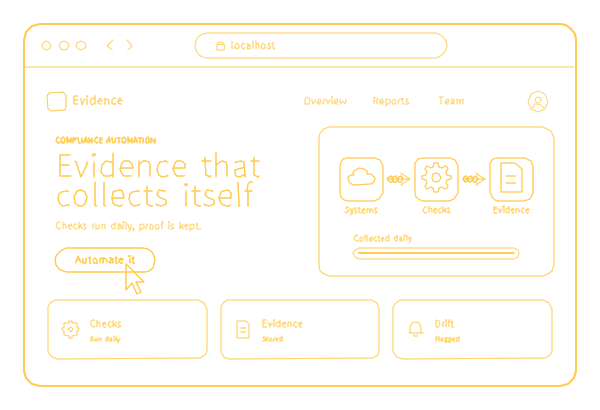
Compliance automation services replace that scramble with checks that run on their own, evidence that collects itself and an alert on the day a setting drifts. I have been building software for 18 years, and my team of 70+ specialists builds, runs and maintains the kind of systems this automation watches. Below: what automation takes off your hands, what it cannot do, when a platform is enough, what changes in financial services, what the federal government learned about automated evidence, and what drives the cost.
Compliance automation services: the short version
| What | How it works |
|---|---|
| What gets automated | Evidence from your cloud, code and HR tools; daily control checks; alerts on drift; scheduled access reviews; reports for SOC 2, ISO 27001, HIPAA or FedRAMP |
| What stays with people | Policies, approvals, risk decisions and the auditor's opinion |
| Platform or custom | We set up a platform, write the parts it misses or build the whole thing |
| Price | An individual estimate; the first call and the rough estimate are free |
What automation takes off your hands
Automation does the collecting, the checking and the reminding, every day instead of once a year:
- Evidence pulled from your systems. Configuration exports, logs and user lists come from the cloud, the code repository and the HR tool with their dates attached, instead of screenshots someone took.
- Controls checked every day. Encryption on, logging on, backups completed: a check that runs daily turns an annual surprise into a Tuesday task.
- Alerts when something drifts. A storage bucket made public, or a former employee who still has access, shows up within a day, not at the next audit.
- Access reviews on schedule. The review lands with the right manager on time, and the decision is recorded.
- Reports in the auditor's format. For SOC 2, ISO 27001, HIPAA or FedRAMP, built from the same evidence.
What automation cannot do
Automation collects evidence; it does not judge it. Four limits are worth knowing before you buy anything.
- It signs nothing. A SOC 2 report comes from a CPA firm under AICPA standards, and an ISO 27001 certificate from a certification body.
- It cannot fix a missing control. Automating the evidence of a broken process gives you well-organized proof of a broken process.
- It does not decide. Approving an exception, accepting a risk and signing a policy stay with people; automation can only schedule them and record the decision.
- It needs owners. An alert nobody owns is noise, and noise teaches people to ignore alerts.
In October 2026 I read four of the pages Google ranked for this search: a product page and three blog posts. None published a price, and the word "CPA" did not appear on any of them. Four pages are a small sample, but the same year the AICPA, which sets the standards for SOC reports, published warnings about quick-turn SOC engagements and "fast and easy" promises. Speed in collecting evidence is welcome; speed in the opinion is not something to buy.
That is why we offer consulting services with compliance automation, not automation alone: someone has to decide what each check means before it runs.
A platform, custom software or both
Compliance automation platforms cover the common frameworks; your own systems often need custom connectors and checks. We set up the platform, write the missing parts or build the whole thing, depending on what you run:
| What you run | What fits |
|---|---|
| Mainstream cloud and SaaS tools, one or two common frameworks | A platform, set up and connected |
| In-house applications, an older database, a tool outside the platform's catalog | The platform plus custom connectors and checks |
| Rules of your own, such as lines of business or jurisdictions, or evidence no platform models | Custom software |
Whether you hire a compliance automation company or a software team, ask the same question first: what happens to the systems the platform does not reach? Those can be the very systems that hold your regulated data.
How it goes
The first checks go live on the evidence that costs you the most hours today, not on the framework's full list.
- A free first call. You tell us what your team collects by hand, for which audit and by when. If you need an NDA, we sign it before you share details.
- A rough estimate, also free, then a contract with the scope and the price before work starts.
- The first checks. Together we pick the evidence to automate first and confirm the control behind each check actually works.
- Connections. We set up the platform or write the connectors, and every check gets an owner and a threshold before it goes live. Building work runs in two-week sprints, each ending with a demo.
- Running and tuning. Alerts go to their owners; a check nobody acts on gets fixed or removed. Your team runs it from there, or we keep it running every month.
On your side: read access to the systems in scope and one person who decides what a failed check means.
Financial services compliance automation
For banks, lenders and fintech companies, the automation follows three threads: rule changes tracked as tasks, records kept for the periods your compliance officer sets, and evidence for examiners collected as the work is done, not assembled when the exam letter arrives.
We have built the first thread before. For PBM Source, a compliance platform for pharmacy benefit managers, new laws, regulations and guidance are identified and uploaded to the dashboard automatically, as compliance tasks with a summary, a jurisdiction and a date, with daily updates.
Each requirement is marked by line of business, so a team sees only the rules that concern it, and that filter was the hard part. The industry is healthcare benefits, not banking, but any financial services compliance automation software needs the same pattern. The case: PBM Source.
Evidence automation for financial services compliance works best when it starts from records you already keep: approvals, access changes, transaction alerts. The rest of that work is under financial compliance.
What FedRAMP learned about automated evidence
FedRAMP, the GSA program that helps federal agencies choose cloud services with the right safeguards, now has a newer path called FedRAMP 20x, built on automated validation. Its principle is worth borrowing: continuous evidence of what is happening is stronger than a policy saying it should happen.
In the 2025 pilot, which ran from April to September, FedRAMP received 26 complete packages. The reviews that went fast had things in common:
- machine-readable evidence in a consistent format;
- short context for each piece of evidence;
- clear failure criteria;
- assessors who could read the code that ran the checks.
Those are good rules for any automated evidence, federal or not. Before you buy FedRAMP compliance automation services, or any other kind, ask how the evidence meets them.
What compliance automation services cost
Each project gets an individual estimate; the first call and the rough estimate are free, and the price is in the contract before work starts. The table shows what moves the number, so you can see where you stand before the call.
| What drives the cost | Lower | Higher |
|---|---|---|
| Frameworks | One, such as SOC 2 | Several at once, mapped to shared controls |
| Systems to connect | Mainstream cloud and tools a platform already supports | In-house apps, older databases, servers in your office |
| Controls today | They work; only the evidence is manual | They have to be built first |
| Platform | One you already pay for | None, or a fully custom build |
| Evidence today | Logs and exports already exist | Screenshots and emails to replace |
| After launch | Your team runs it | We keep it running and tuned every month |
When most of the evidence lives in AWS, Azure or Google Cloud, see also cloud compliance; when the goal is a certificate, ISO 27001.
What stays with you
Automation you cannot take with you is a subscription, not an asset. Three things should stay with you, whoever builds it:
- The checks, scripts and connectors. With us, the code we write for you is yours once it is paid for.
- The evidence. Keep it in your own accounts, so it outlives any vendor, us included.
- The map of what each check proves. Written down, so your next auditor or engineer can read it without a meeting.
Not sure what to automate first? Start with regulatory compliance consulting. If the answer is a tool of your own, that is compliance software development. All our work in this field is under compliance.
Where to start
Tell us what your team collects by hand today. We reply with what we would automate first and a rough estimate, free. On weekdays, 9:00-18:00 Miami time, new requests get an answer within 30 minutes.
