The article
Your company has grown, and so has everything nobody has looked at since: accounts of people who left, a cloud account set up in a hurry, an app a contractor built three years ago. If you cannot say what holds and what fails, it is time for cyber security audit services: someone from outside checks your security against a standard and tells you what to fix first.
I have been building software for 18 years, and my company, 26 Lines of Code, has 70+ specialists who build and maintain software and the servers and cloud accounts it runs on. One thing up front: our audit is not a certificate.
Cyber security audit services: the short version
| What | How it works |
|---|---|
| Standard | NIST CSF, ISO 27001, CIS Controls, the SOC 2 criteria, HIPAA, or your own and your clients' requirements |
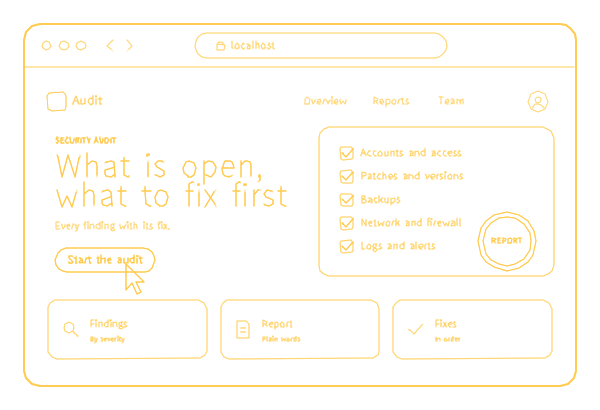
| Result | Each finding with what we saw, why it matters, its severity and the fix, plus a summary for management |
| After it | Our developers and DevOps engineers can close the findings; we check each fix again |
| Not included | A certificate or an attestation report |
| Price | Estimated before work starts; the first call and the rough estimate are free |
What we check, area by area
IT and cyber security audit services list similar areas; what differs is whether someone reads the settings and the code or only asks questions. We read them:
- Policies and roles: who owns security, and whether people follow what is written.
- Accounts: who reaches what, accounts of people who left, two-factor sign-in for admins.
- Servers and networks: updates, and what faces the internet.
- Cloud accounts: who can reach your data, and the logs that show who did.
- Applications: their code and its libraries.
- Backups and the incident plan: whether anyone has tried a restore.
Evidence is easier when software keeps its own record. RxPhoto, where we worked on the backend, the web front end and the API behind the mobile app, has an audit log of who opened which patient record and when.
An audit is not a certificate
An ISO 27001 certificate comes from an accredited certification body, and a SOC 2 report from a CPA firm. We are neither. Our part is the work around theirs: an audit against the same criteria before their auditor arrives, the fixes, and the evidence that auditor will ask for. If a certificate is the goal, start with audit consulting; the standard itself is on ISO 27001 compliance.
Before day one: the evidence list
In October 2026 I read the five audit pages Google showed for this search. Two publish prices and two list what you get at the end, but none says what you should prepare. Five pages are a small sample; this list fills that gap, because much of an audit's time goes into finding things:
- Your systems and who owns each: cloud accounts, servers, applications, the office network, laptops.
- Everyone with admin rights, and when that list was last reviewed.
- Proof of two-factor sign-in: an export or a screenshot, not "it should be on".
- Your written policies, even short ones.
- The date of the last backup restore someone actually tried.
- The incident plan: who is called first, with phone numbers.
- Vendors who can reach your systems or data.
- What you are audited against: the questionnaire, the standard or your own policy.
A gap in this list is the first finding, not a reason to wait. Crop customer data out of screenshots: the auditor needs the setting, not the names.
What happens after the report
Our developers and DevOps engineers can close the findings, in the code when that is where they sit, and we check each fix again so it is on record. That is remediation.
One honest note: a cyber security audit company that also sells the fixes has a reason to find more. What keeps that in check is evidence you can verify yourself and a list that is yours to hand to anyone. Every access you give us goes on a list too, so at the end you know what to revoke.
Where to start
An audit shows what you have; a penetration test shows whether it holds, and a risk assessment shows where the money goes first. Send us the questionnaire or the standard you are measured against. On weekdays from 9 am to 6 pm Miami time we answer new requests within 30 minutes, then send a suggested scope and a rough estimate, free. If you need an NDA, we sign it before you share details. To check any security firm before you hire it, us included, use the checks on our cybersecurity page.
