The article
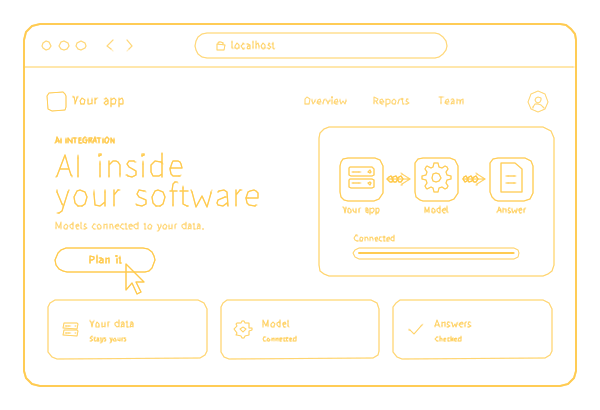
Your product works, people use it every day, and the question from your board, your sales team or your users is the same: where is the AI? The useful answer starts with a narrower question: which task inside your product would a model do faster than the person doing it now? AI integration services exist for that task: a feature where a model does part of the job, built into software that already works and connected to your data under the access rules you already have.
I have been building software for 18 years, and since 2017 my company, 26 Lines of Code, has grown to 70+ specialists who build and support software. This page is about AI integration for business software that already exists: which features are worth it, how the data stays where it belongs, how a test set checks a feature before it ships, and a checklist to run on any AI feature before release, ours included.
AI integration services: the short version
| What | How it works |
|---|---|
| What we add | Search that answers in sentences, with sources; summaries; forms and documents read into your fields; replies drafted for a person to send; tags, routing and priorities; translations |
| Into what | Software you already have, through its code and APIs |
| Your data | A model sees only what the person asking may see |
| Before release | Answers checked against a test set of real questions |
| After release | Costs watched, every call logged, the feature tuned |
| Price | An individual estimate; the first call and the rough estimate are free |
Six AI features worth integrating
Each of the six AI integration solutions below needs something from your side, and the last column says what.
| Feature | What the user gets | What it needs from your side |
|---|---|---|
| Search that answers in sentences | An answer with links to its sources, not ten documents to read | The documents, and who may see which |
| Summaries | Long threads, calls and reports in a paragraph | Access to where they live |
| Forms and documents read into your fields | A scan or a PDF turned into filled-in fields to check | Examples of each kind of document |
| Replies drafted for a person to send | A first draft waiting in the reply box | Past replies you are happy with |
| Tags, routing and priorities | New items sorted before anyone opens them | Your categories, and who handles what |
| Translations | Content and messages in the user's language | The languages, and the words that must stay as they are |
Drafting and summing up are the generative part of AI integration; reading, tagging and routing are the rest, and we build both. If the feature is an assistant that talks to your customers, it has its own page: AI chatbot development.
Integration that respects your data
An AI feature inside your product has to follow the same rules as the rest of it. We build three of them in:
- Access. A model sees only what the person asking may see. If a user cannot open a document in your product, the AI cannot quote it to them.
- Location. Hosted models from the major providers work through their APIs, under the provider's business terms; when the data cannot leave, open models run on your own servers. We agree which before we build. Our AI call center for the UAE keeps all AI processing inside the country.
- Record. Every call is logged, so you can see what the model did and why.
A test set before every release
A model can sound right and be wrong. So before release, every feature is checked against a test set: real questions or real documents from your product, each with the right answer written down by someone who knows it. Answers are grounded in your data with the sources shown, so a user can see where an answer came from.
After release we keep watching the answers, the costs and the questions the test set did not foresee, and we tune the feature. A test set is also how you hold any vendor to account: if they cannot show you one, they do not know how good their feature is.
How an AI integration goes
- Pick. We choose with you the feature where AI saves the most time, and how we will measure it.
- Prototype. A working version on your real data, measured against the test set.
- Integrate. The feature is built into your product with access rules, logging and limits.
- Release. It ships to your users, then we watch it and tune it.
Do you need to rebuild your software first? No: most AI features connect through the code and the APIs you already have, and we tell you early if something in the way has to change. Your part is access to the code or the APIs, real examples, and a person who can say whether an answer is right. An NDA, if you need one, is signed before you share any details.
What it costs to build and to run
Building is estimated after we see your product: how many systems the feature touches, the state of the data and how accurate it has to be. The first call and the rough estimate cost nothing, and the contract fixes the price before work starts.
Running is the second number, and the easier one to forget. A hosted model is billed per use; your own servers mean hardware, and GPUs are expensive. We watch the costs after release and build in limits, so a busy month does not turn into a surprise. When you compare AI integration companies, ask each one for both numbers.
Our work: generative AI inside After Effects
The AAE Plugin is an AI integration into software people already use all day: Adobe After Effects. Every trip out of After Effects to an AI tool, and back with the result, cost motion designers time, so the client wanted AI where the work already happens.
We took it from a technical demo to a product: tools inside the After Effects interface that generate and edit images and short video fragments, in-painting with masks so the AI changes only the part of the frame the artist marks, licensing by subscription tier with usage statistics and API limits, and one admin for tasks, licenses and hardware. The hard part was moving images, masks and video frames together from the plugin to the models and back. Models change fast and GPUs are expensive, so the backend swaps models without a plugin update, and an asynchronous GPU worker architecture ended the cost of idle hardware.
A pre-release checklist for any AI feature
In October 2026 I opened Google's first page for this search. Only two results were pages of companies that sell AI integration; the rest were a forum thread, a product's integration listing, a contractor's brochure, a list of tools, a developer forum and a university center. Neither company page publishes a price or says how a model's answers are checked before release. Two pages are too small a sample for any statistic, so here is the list I would run instead, on our features and anyone's:
| Check | How to run it | A good result |
|---|---|---|
| Access | Sign in as a user with limited rights and ask about something they cannot open | The AI does not reveal it |
| Sources | Ask five questions and open the sources it shows | Every answer points to a real place in your data |
| Test set | Ask for the test set and the latest results | Real questions, the right answers and a score you can track |
| Unknowns | Ask something your data does not cover | It says it does not know, or passes to a person |
| Cost | Ask for the cost per use and the monthly limit | Both, in numbers |
| Logs | Pick one answer from yesterday and ask what happened | The log shows the request and the answer |
| People | Check which actions it takes alone | It drafts; a person sends, approves or pays |
| Location | Ask where the model runs and under whose terms | A named provider's API, or your own servers |
Testing a feature the way an attacker would, against prompt injection and data leaks, is a service of its own: AI cybersecurity.
AI integrators, consultants or your own team
There are three ways to get an AI feature into your product:
- AI integrators like us build and ship the feature end to end: pick, prototype, integrate, release. That fits when you know which task the AI should take on.
- AI integration consulting comes first when you do not know yet where AI pays off. Our AI consulting ends with a ranked list of tasks, a check of your data and a plan for the first piece.
- Your own team with ours inside it. Our engineers can join your developers through staff augmentation, from $35 an hour depending on the role.
If the work is routine across your tools rather than a feature inside your product, that is AI automation; everything AI we build is under AI development. Tell us where AI should help in your product, and we reply with the first feature we would build and a rough estimate, free.
