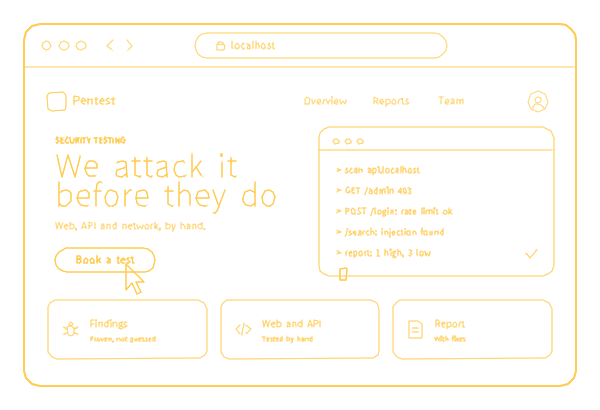
The article
Your largest client wants a penetration test report before it signs, or your app goes live next month and nobody has tried to break it. Either way, you are comparing cyber security testing services, and every quote promises to find your weak spots. The real difference comes after the report: who fixes the findings, and whether anyone checks the fixes.
I have been building software for 18 years; my company, 26 Lines of Code, has 70+ specialists, developers, QA and DevOps engineers among them. The company that finds a hole in your app can also close it.
Cyber security testing services: the short version
| What | How it works |
|---|---|
| What we test | Web apps and their sign-in, APIs, iOS and Android apps, cloud accounts, networks, and your team with phishing tests |
| How | Scans plus hands-on attacks, done carefully on live systems or on a copy |
| The report | Each finding with proof, severity and the fix |
| After the fixes | We test again and confirm they hold |
| Price | Estimated before work starts; the first call and the rough estimate are free |
A scan, a penetration test and an audit
A vulnerability scan is a program that looks for known weaknesses: fast, broad and blind to your business logic. A penetration test adds people who try to break in the way an attacker would, chaining small weaknesses into a real one. An audit checks controls and records instead. Our cybersecurity penetration testing services use both: the scan for breadth, people for the attacks that need judgment.
How a test runs
- Scope, in writing. What we test, how deep and when. From you: test accounts for each role, a staging copy if you have one, and a person who can pause the test.
- The test. Scans and hands-on attacks, done carefully on live systems or on a copy.
- The report. Each finding with proof, severity and the fix.
- The retest. After the fixes we test again and confirm they hold.
For companies that need cyber security testing services in the USA, the time zones help. Our team in Europe is usually seven hours ahead of Miami, so a test window outside your office hours falls inside its working day.
Where a test earns its price
Scanners find missing updates and known weaknesses; they do not understand your roles or your money. Take Tarot Fans, a marketplace app we built: clients and experts share one app with different homes, and a wallet moves money both ways, with Stripe underneath. The questions that matter there are whether one role can reach the other's screens and data, and whether a balance can change without a payment behind it. No scanner asks them.
If a quote leans on AI-driven cybersecurity testing services, ask what the AI does and what people do. With us, AI does the scanning and the first pass, and people do the attacks that need judgment, like the two questions above. We do not train AI on our clients' code; more on where AI speeds up our work.
Red flags in a penetration test quote
Quotes for cyber security penetration testing services look alike on paper. These lines tell them apart:
| Red flag | Why it hurts | Ask for |
|---|---|---|
| A scan sold as a penetration test | It finds known issues and misses your logic | Which findings a person verifies by hand |
| No retest | You pay for a list, not for proof the holes are closed | A retest after your fixes, in the scope |
| No written scope | Nobody knows what was in, what was out, or whom to call | Targets, depth, dates and contacts on paper |
| A request for your admin passwords | The test leaks the keys it should protect | Test accounts for each role, removed afterwards |
| Findings without proof | You cannot tell a real hole from a scanner's guess | Steps to reproduce every finding |
| Screenshots full of customer data | The report becomes a second leak | Evidence with real data cropped out |
We hold ourselves to the last row: for the site of Clemond, our own product, we built a replica of the app instead of using screenshots, because real screenshots contain real people.
In October 2026 I read the five pages Google showed for this search, including the answers folded under their questions. None mentions a retest, and none publishes a price. Five pages are a small sample, so take it as a reason to ask, not as a statistic.
When the test finds a hole in the code
This is where testers and developers in one company pay off. Our developers can close the hole and the testers confirm the fix, whoever wrote your software; that work is remediation. Many clients expect a test once a year and after major changes. Whether your standard requires one is a question for your compliance advisor; card payments have their own page, PCI DSS compliance.
Tell us what to test. On weekdays from 9 am to 6 pm Miami time we answer new requests within 30 minutes, then reply with a suggested scope and a rough estimate, free. If you need an NDA, we sign it before you share details. The rest of our security work is under cybersecurity.
