The article
Your site has outgrown its template. Booking has rules no plugin follows, the site has to talk to the systems you already run, or the design has to belong to your brand and no one else's. That is when people start looking for custom website developers or a custom web development agency, and the questions that matter are no longer about portfolios: the cost, who controls the budget and what you own at the end.
I have spent 18 years in software development; since 2017 my company of 70+ specialists has delivered 150+ projects. Below: whether you need custom website design and development services at all, how we price and build it, and how to check any developer before you sign, us included.
Template, custom or web application
Three different things get sold as "a custom website", and the difference decides the price.
| Site on our template | Custom website | Web application | |
|---|---|---|---|
| Its job | Presents the business, brings calls and requests | Does work by your rules: booking, calculators, integrations | People log in and work in it: accounts, roles, dashboards |
| Design | Your colors on our template | Drawn for your brand from scratch | Built around the tasks people do in it |
| Price | $499, paid upfront; payments or booking plus $500 each | By the hour or by milestones, after a free estimate | First version from $5,000 |
The line between the last two columns is simple: a website is read, a web application is worked in. Payments alone do not make an application: Somatic Reset takes the payment before every session and is still a site. Accounts, roles and data that users change every day are where web application development begins. If that is your case, our custom web application development services cover customer portals, SaaS products, marketplaces and internal tools.
When custom is worth it, and when it is not
Custom pays off when the site has to do work a template cannot:
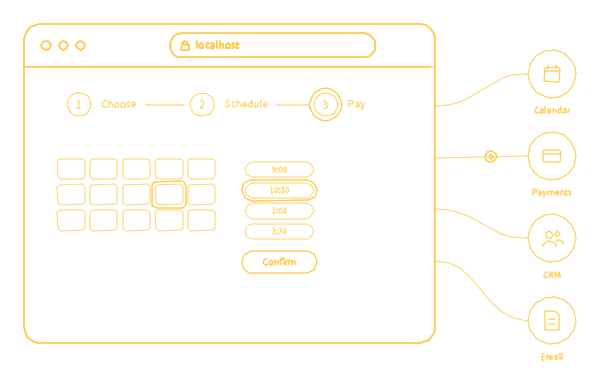
- Rules of your own. Somatic Reset's booking follows the owner's weekly hours, exceptions, buffers, minimum notice and booking horizon, and holds a slot for 10 minutes while the client pays.
- Tools that answer a question. BND, an accounting firm, had a theme-based site that search engines could not place. The new one has three tax calculators, a deadline calendar that feeds the client's phone and 108 indexable pages in three languages.
- Integrations. Payments, calendars, messengers and the systems you already run, connected so nobody copies data by hand.
- A design that is part of what you sell and cannot look like anyone else's.
You do not need custom when:
- The site has to present the business and bring calls. A website from $499 gives you up to 20 pages, an admin and basic SEO.
- You need online payments or booking and nothing else. On the $499 site, each is an add-on at $500.
Not sure which case is yours? Web development consulting turns an idea into requirements, a stack and an estimate.
How custom web development is priced
A custom site has no list price on our pricing page: the price follows the scope. We price our custom web design and development services in two ways, both after a free estimate and before any contract.
- By the hour. You pay every two weeks for the time actually spent. This fits when the scope will move: a new product, or an integration whose limits nobody knows yet.
- A fixed price, paid by milestones. Scope, budget and timeline are fixed before the start. The total for the agreed scope cannot exceed the agreed price, so most of the risk of underestimating it is ours. Anything new gets its own estimate and your approval before we build it.
The estimate grows with unique page designs, rules in the logic, integrations, languages, content and old addresses to move, and the tests a payment path needs.
How we build a custom website
- A first call, free. You tell us what the site has to do and for whom. If you need an NDA, we sign it before you share the details.
- A rough estimate, free, built on your written answers to our questions.
- A contract with our US company: scope, budget, timeline and payment terms.
- Documentation first. Requirements, user stories and a spec for every feature; Somatic Reset started from 38 written specs. You approve the plan and the design direction.
- Two-week sprints, each ending with a demo of working software. Routine code is written with AI tools and checked against each task's definition of done; an engineer reviews it and our tester runs the final QA. Design and architecture decisions stay with people; more on where AI actually speeds up a build.
- Launch on your domain. If the old site has search history, every old address gets a permanent redirect; that is how BND carried its rankings through the move.
The timeline comes with the estimate. For scale: Somatic Reset went from an approved plan to production in 8 days, BND from the first commit to a live domain in about two days. Every step of the start: from first call to first release.
What you own at the end
- Code and design. Everything written and drawn for your project is yours once it is paid for: whoever pays owns it.
- The domain. You register it and pay the registrar yourself, so the address of your business never depends on us. An existing domain we connect.
- Analytics and Search Console. They live in your accounts. If you have none, we set them up on ours with access for you and hand them over when you leave.
After launch, website maintenance for the sites we build starts at $29 a month, billed annually ($348): hosting, any bug in our work fixed at our expense and help with content changes. New features get their own estimate before any work on them.
The risks of custom, and how we control them
Custom web programming adds freedom and new ways to go wrong. The risks I watch most:
- The budget grows with every idea. On a fixed price, new scope waits for its own estimate and your approval; on hourly work, the bill comes every two weeks, not as one surprise at the end.
- The money path breaks. On Somatic Reset, a slot is reserved under a transactional lock, a payment counts only after a signed webhook and a fresh read from Stripe, and 157 automated tests run on the site.
- The site is slow on a phone. BWI went from 77 and 74 to 100 in Lighthouse on mobile once the loader left the critical path and the first download on a phone was halved.
- Features that impress developers, not buyers. For the same site we built a 3D villa of 1,980 parts that assembled itself on scroll, then cut it: it looked like a game engine, not a photograph of a house.
- Knowledge leaves with a developer. Specs are written before the code, so the next person starts from documents, not from someone's memory.
How to choose custom website developers
Ask any custom website development company, us included, these questions before you sign:
| Ask | A good answer | Ours |
|---|---|---|
| Who owns the code and the design once I pay? | You, in the contract | You |
| Whose name is the domain in? | Yours, at your registrar | Yours |
| Whose accounts hold analytics and Search Console? | Yours, with admin rights | Yours, or ours and handed over when you leave |
| How do you price a change? | In writing, before the work | Estimated and approved before we build |
| How often will I see working software? | At least every two weeks | A demo every two weeks |
| Who tests, and how? | Automated tests and a person | Automated tests and a final QA by our tester |
| Where can I read reviews you do not control? | A third-party platform | 5.0 on Clutch from 26 verified reviews, September 2026 |
Where to start
If your site only has to present the business, start with the $499 one; the rest of our web development services are on one page. If it has to do work of its own, describe that work, and you get our approach and a rough estimate before any contract.
