The article
Somebody has asked you for an AI plan: a board member, a partner, or you yourself after a conference. Now there are a dozen ideas on the table, from a chatbot to "AI that reads our contracts", and nobody can say which of them is worth money. Artificial intelligence consulting should end that with a short ranked list, a check of your data, a cost model and a first piece small enough to test.
I have been building software for 18 years, and since 2017 my team of 70+ specialists has delivered 150+ projects, AI products among them. Below is what our consulting delivers and how it runs, a scorecard to rank your ideas before you pay anyone, and the three answers a consultant must be free to give: build, buy or wait.
Artificial intelligence consulting services: what you get
You get five things, each written so that your own team could act on it without us:
- The tasks AI can take on, ranked by value. Concrete tasks, like "sort incoming invoices" or "answer where-is-my-order", each with how often it happens and what it costs you now.
- A check of your data. Whether there is enough of it, whether it is clean, and whether it lives in your systems or in people's heads.
- Build, buy or wait for each task, with the reasons.
- A cost model: what building costs, what running costs each month, and the hours it frees.
- A plan for the first piece, with how you will tell that it worked.
Artificial intelligence business consulting that stops at slides leaves you with ideas; the fifth item turns one of them into a test.
From a workshop to a pilot
Our consulting runs in four steps, and the last one is allowed to fail.
- Workshop. Your processes, your data and your goals in one conversation. Bring the people who do the work, not only the people who manage it, and examples of the documents, emails or calls the work runs on.
- Assessment. Where AI fits, where it does not and what each idea would take.
- Plan. The first piece to build, its cost and how to tell that it worked.
- Pilot. A working version on your data, ready to grow or to stop.
A pilot that cannot fail tells you nothing, so its measure is agreed before it starts: hours saved on a task, the share of questions answered without a person, errors caught before they cost money. An NDA, if you want one, is signed before you share a single detail. The first conversation is free, and we reply with where AI could help and how to check it; the assessment and the pilot get an individual estimate before they start.
Score your AI ideas before you pay anyone
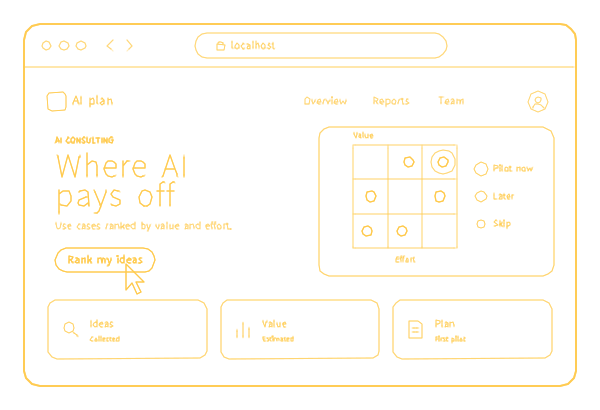
You can rank most ideas yourself with six questions and the people who do the work. An idea that is ready for a pilot looks like the middle column:
| Question | Ready for a pilot | Not yet |
|---|---|---|
| How often does the task happen? | Daily or weekly, for several people | A few times a year |
| Can someone say what a right answer is? | Yes, and there are examples | "It depends" every time |
| Where is the data? | In your systems or documents | On paper, or in people's heads |
| What does a wrong answer cost? | Little: a person checks before it matters | Money, health or a promise, with nobody checking |
| Where may the data go? | Decided: a hosted model or your own servers | Nobody knows yet |
| Who checks the output in the first month? | A named person with time for it | Nobody |
Ideas that pass all six go to a pilot now. A "not yet" on the second or the fourth question means later, whatever the value: without a right answer you cannot test the result, and a mistake nobody checks can cost more than the task saves. A task that happens a few times a year is usually a skip.
Build, buy or wait
A consultant who only ever says "build" is selling, so here is when each answer is right.
- Buy when a ready tool already does the job. A chatbot builder is enough for answers from a page of FAQs, and an off-the-shelf writing assistant is enough for one person's drafts.
- Build when the AI must work inside your systems and your rules, keep data where you decide, or know a catalog too large for a ready tool. Depending on where it lives, that is AI chatbot development, AI integration or AI automation.
- Wait in two cases people rarely hear about. The process itself is broken, and automating it only makes the mess faster. Or the model you need is not good enough yet and is improving quickly: then build the data and the process now and add the model when it is ready.
Building now for a better model later is how we made the After Effects plugin: its backend can change the AI model without an update to the plugin, so a better model goes live without a new release. The longer list of when custom AI does not pay off is on our AI development page.
Where your data may go
Decide where the data goes before you choose a tool, because it changes the cost and sometimes the whole plan. In October 2026, Google's first page for this search held four pages from companies that sell AI consulting; the rest were forum threads and LinkedIn posts. None of the four says where your data would go when a model reads it, and only one mentions a pilot, in a single sentence. Four pages are a small sample, but those are the two questions I would ask first.
In our assessment, every idea gets one of two setups:
- A provider's hosted model, used through its API under the provider's business terms: the quick start, paid per use.
- An open model on servers you control, when the data may not leave them. That is the setup of the AI Call Center we built in the UAE, where all AI processing stays inside the country.
Ask your compliance advisor which of your data may go to a provider's model; we bring the technical options with their costs and build the setup they approve.
Artificial intelligence consultants who build
Our consultants are the engineers who build our AI software, so the plan is one we know how to build, and it comes with a working prototype when you need one. Four examples show what that means:
- A product we co-founded. HirePilot is a job search product, and we built all of it: its AI finds the hiring manager at a target company and drafts a personal message, while a browser extension fills in the application. It launched as #13 Product of the Day and has a 5.0 rating on Product Hunt.
- A cost model built into the architecture. The After Effects plugin starts its GPU workers only when there is a task, so nobody pays for hardware that sits idle.
- A first piece the size of one button. In the admin of the Muzychko Vocal School site, any text is translated by AI with one click.
- AI in our own work. A person works in a pair with AI agents: routine goes to the agents, decisions stay with the person. We do not train AI on our clients' code; we build into our agents the best practices my team has arrived at over the years. The post on where AI actually speeds up a build shows where it saves time and where we hold it back.
That is the difference from an artificial intelligence consulting firm that hands over a report: the people who plan your AI are the people who would build and run it.
Generative AI consulting for business: where each use goes wrong
Each kind of generative AI does one thing well and fails in a predictable way, and a good plan names both. The person's job in the last column is what keeps a human in charge of the decisions:
| Use | What it does well | Where it goes wrong | The person's job |
|---|---|---|---|
| Assistants for customers and staff | Answers from your documents and systems, at any hour | Documents that contradict each other, questions outside them | Owns the rules and takes the handover |
| Drafting and summing up | First drafts of replies, summaries of long threads, calls and reports | A draft sent without reading | Reads, fixes and sends |
| Reading documents | Fields from forms and invoices moved into your systems | Poor scans, a layout that changes | Checks the exceptions |
| Voice agents that take calls | Routine calls at any hour | A caller who needs judgment, or is upset | Takes the call over |
In every row the AI takes routine work off people, and in no row does it make the final call on money, health or a promise.
When you already know what to build
If the idea is settled, you do not need a plan; you need an AI integration consultant who will build it. Tech consulting for AI integration starts on our AI integration page, where the first feature is picked with you and tried on your real data before it reaches your users. A small business that wants to hand over one routine first can start with AI automation for small businesses.
If you are not there yet, tell us about your business: the work that eats your team's week and the ideas already on the table. We reply with where AI could help and how to check it, free.
