The article
Your company is about to do something new: sell to hospitals, take card payments, sign a defense contract or open to customers in Europe. Each of those brings rules with it.
And nobody inside the company can say which rules apply and what they will change in your systems. That is usually the moment people start comparing regulatory compliance consulting firms.
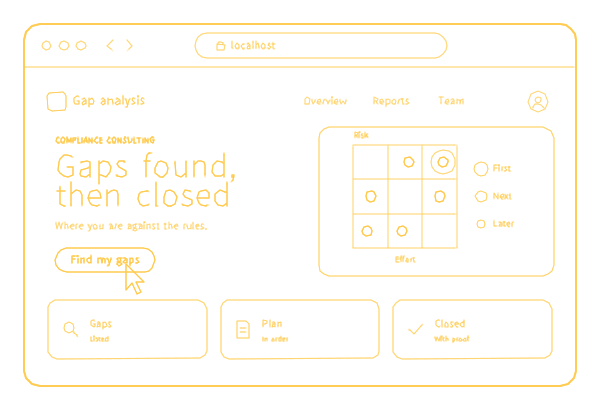
A good firm will give you a solid document: the rules, the gaps, a plan. Then the document waits, because many of its lines are changes to software, and writing software is not what consultants are hired for. I run a software company, so we write the plan and then carry it out in your systems ourselves.
I have been building software for 18 years. Since 2017 my team of 70+ specialists has delivered 150+ projects across healthcare, fintech, logistics and e-commerce, and clients rate us 5.0 on Clutch from 26 verified reviews, as of September 2026, none of them negative. Below: what our consulting includes and what it does not, how it goes, what drives the price, and the red flags I would check in any firm before signing, us included.
The short version
| What | How it works |
|---|---|
| For whom | A new rule, a new market, a first audit or a client's security review |
| What you get | The rules mapped to your systems, a gap analysis, a plan with owners, dates and costs, procedures your team can follow, and preparation for the audit |
| Beyond paper | Our engineers make the changes in your systems, if you want them to |
| Not included | Legal opinions, certificates and attestations |
| Price | An individual estimate; the first call and the rough estimate are free |
What regulatory compliance consulting firms should hand you
Five things you can hold, each with a name on it. Ask for all five, whoever you hire.
- A map of the rules. Which rules apply, confirmed by your counsel, and which of your systems, data and vendors each one touches.
- A gap analysis. What is missing against each rule, ranked by risk and by what an auditor or a client's reviewer will check.
- A plan. An owner, a date and a cost for every gap.
- Procedures your team can follow. Who reviews access, who approves a change, what happens when a laptop goes missing.
- Audit preparation. Evidence collected and organized as the work happens, so nobody rebuilds it the week before.
Compliance and regulatory consulting that stops after the third item is a reading assignment. The last two items hold most of the work and most of the risk, and a consultant who cannot touch your systems hands exactly that part back to you.
Advanced regulatory compliance consulting: the plan reaches the code
When a rule reaches into your software, our engineers change the system, so the plan does not stall at a document. Four places where rules land in code:
- Consent: a record of what each person agreed to and when, and a form that will not submit without it.
- Retention: records archived or deleted on schedule by the system, not by a calendar reminder.
- Audit trails: who opened, changed or exported a record, and when.
- Access: roles that match the job, reviews that leave a record, and access removed when someone leaves.
A regulatory and compliance consulting service that cannot change your systems leaves you with two vendors to coordinate: the one who wrote the plan and the one who builds it. With us it is one team, and the person who found a gap sees it closed.
Where we stop: legal questions go to your counsel, and certificates and attestations come from accredited bodies, assessors or CPA firms. We give no legal opinions and issue no certificates.
How it goes
- A free first call. You tell us what changed: a rule, a market, an audit date. If you need an NDA, we sign it before you share details.
- Questions and a rough estimate, also free.
- A contract with the scope, the price and the timeline, before any work starts.
- The map and the gap analysis. We read your systems, not only your documents: the cloud accounts, the code repository and the main tools, with read access. Interviews fill in what the systems cannot show.
- The plan and the changes. Your team, another vendor or our engineers carry it out. If it is us, the work runs in two-week sprints, each ending with a demo.
On your side: one person who decides, access to the systems in scope, and your counsel on call for anything legal. More on how our projects start.
What the price depends on
Every engagement gets an individual estimate, and the price sits in the contract before work starts. Four things move it:
- How many rules. One rule is a project; several overlapping ones are a program, though one control often serves several.
- How many systems and vendors. Each one in scope has to be read, mapped and, if needed, changed.
- What is written down already. Current policies and a list of systems shorten the map; with nothing written down, the map starts from zero.
- Who carries out the plan. Advice alone costs less than advice plus the engineering that makes it real.
In October 2026 I read five pages Google showed for regulatory compliance consulting firms: two firms' service pages and the home pages of three firms on Google's map. None published a price, and none showed a sample of what the client receives at the end. Five pages are a small sample, so treat it as a prompt: ask any firm, us included, for a sample deliverable before you sign.
Red flags when you hire a compliance consultant
Forward this table to whoever is choosing the firm. Each red flag comes with the question that exposes it.
| Red flag | Why it matters | Ask instead |
|---|---|---|
| "We will make you compliant" or "we will certify you" | Certificates and reports come from accredited bodies, assessors or CPA firms, and HHS does not recognize private HIPAA certifications at all | Who issues the certificate or the report, and what exactly do you prepare? |
| The gap analysis has no owners or dates | A gap without an owner stays open until an auditor finds it | Can I see a sample plan with owners, dates and costs? |
| They never ask to see your systems | Interviews show what people believe happens; systems show what does | Which systems will you read, and with what access? |
| Everything is marked high priority | Then nothing is, and the budget goes to the loudest item | What would you fix first, and why? |
| Nobody can say who carries out the plan | The plan stalls at the first change to software | Who changes the systems, and at what price? |
| The retainer has no deliverables | You pay for hours, not for gaps closed | What will we hold at the end of each month? |
Our work: what a regulation turns into
Every new rule comes down to the same few things: what it asks, where it applies, from what date and for whom. That model is the core of PBM Source, the compliance platform we delivered for pharmacy benefit managers. New laws, regulations and guidance arrive there as tasks with a summary, a jurisdiction and a date, marked by line of business: fully insured commercial, self-insured, Medicare or Medicaid.
A team lead assigns each requirement with its documents in one place, so nothing is decided in scattered emails, and an analyst reads a short summary before the full text. The principle holds for any consulting plan: if a gap cannot be written as a task with an owner and a date, nobody understands it yet. The case is on PBM Source.
Where we fit, and where a law firm fits better
We fit when your compliance lives in software and in the cloud: a SaaS product, a health tech app, a fintech platform, an online store, a company without a compliance engineer of its own. For security frameworks in particular, see cybersecurity compliance consulting; for the rule-by-rule work, HIPAA, GDPR, PCI DSS, CMMC and ISO 27001.
A law firm fits better when you need a legal opinion, someone to represent you before a regulator or a response to an enforcement action. A pure advisory firm may be the better buy when you already have engineers who will carry out its plan.
If your gaps are mostly about collecting evidence, start with compliance automation; if you need a tool of your own, with compliance software development. Everything else we do in this field is under compliance.
Where to start
Tell us what changed: the rule, the market or the audit date. We reply with the rules we would check and a rough estimate, free. On weekdays, 9:00-18:00 Miami time, new requests get an answer within 30 minutes.
