The article
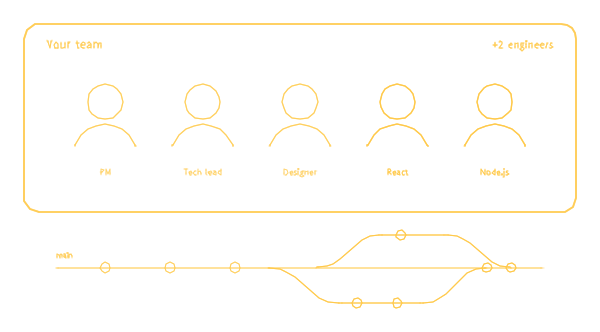
Your tech lead has a roadmap for five engineers and a team of three. Hiring the other two means job posts, interviews and notice periods, and the roadmap will not wait for them. Staff augmentation services exist for exactly this: engineers from an outside company join your team, work in your tools and your process and report to your lead, while that company handles their hiring, payroll and equipment.
I have spent 18 years in software development. My company, 26 Lines of Code, has 70+ specialists: engineers, designers, QA, DevOps and managers. Since 2017 we have delivered 150+ projects, as a whole team and with our people inside client teams. Below: what staff augmentation is and is not, how it compares with managed services and hiring, who can join you and at what rate, how a person is chosen and how the start goes, and a checklist for day one and the last day that works with any vendor.
Staff augmentation services: the short version
| Question | With us |
|---|---|
| Who can join | Developers for web, mobile and AI, QA and DevOps engineers, UI/UX designers, project managers and a CTO |
| Who leads them | Your lead, in your tools and your process |
| Price | From $35 an hour, depending on the role and the experience |
| How you pay | For the hours they work, at the rate of their role |
| Before any contract | The specialists for each role and the price of each, free |
| The contract | With our US company, and an NDA first if you ask |
| Where they work | Our delivery center near Kyiv, usually seven hours ahead of Miami |
On outsourced development and staff augmentation there is no upfront payment, and the first week is on us: if it does not work for you, you stop and do not pay for it. Anyone who is not a fit in that week is replaced at no cost.
What staff augmentation means
The meaning of staff augmentation is simple: you add engineers from an outside company to your own team. They work in your tools and your process, take tasks from your backlog, commit to your repository and report to your lead. A dedicated engineer works only on your project. The company that employs them handles the hiring, the payroll and the equipment, and you pay for the hours they work.
The model has several names. You will also see team extension or software team extension, and an IT outstaffing company and a staff augmentation firm sell the same thing under two names. In software development the work is the same whatever it is called: the people are ours, the direction is yours. And it is not only for developers: QA, design, DevOps and project management can join your team the same way.
Managed services work the other way round. There the outside company runs the work and answers for the result, and you judge the outcome, not the daily tasks.
Staff aug vs managed services: who runs the work
The model decides who leads and who answers for the result. Hiring is in the table too, because it is the real alternative for most teams.
| Staff augmentation | Managed services | Hiring | |
|---|---|---|---|
| Who runs the work | Your lead | We do | Your lead |
| Who answers for the result | You | We do | You |
| Who hires, pays and equips | We do | We do | You |
| What you need on your side | A lead and a process that already work | Someone who sets priorities and comes to the demos | A lead, a recruiter and time |
| Changing the team size | Without hiring or layoffs on your side | We plan the team | Hiring and layoffs are yours |
| Fits when | Capacity is your bottleneck | You want a result, not more hands | The skill is core to your company for years |
We do the first two. Our managed side is IT outsourcing, where a full team runs the project from discovery to DevOps. If you are torn between the two, our short guide to outsource or outstaff settles most cases with four questions. The choice is not forever either: a product built by an outsourced team can later move to augmented engineers working under a CTO you hire. Agencies have a third option: resell our development under their own brand, or refer clients and earn a commission on every project, not only the first.
Who can join your team, and at what rate
Rates start at $35 an hour and depend on the role and the experience. You get the specialists for each role and the price of each before any contract, free. The roles a product usually needs:
- Engineering: frontend, backend and full-stack developers; iOS, Android and Flutter developers; AI engineers.
- Quality and operations: QA engineers and DevOps engineers.
- Product and leadership: a CTO, project managers and UI/UX designers.
The stack they bring: React, Next.js and Vue; Django, FastAPI and Laravel; Swift, Kotlin, Flutter and React Native; PostgreSQL, Redis and Supabase; Stripe, Twilio and Auth0. A role that is not on the list - ask.
One person or a whole squad works the same way. Software development team augmentation at squad size means dedicated engineers, a QA engineer and a project manager join your process together, and the team grows or shrinks as your work changes, without hiring or layoffs on your side. A squad works in your process, Scrum or Kanban; if you do not have one yet, we bring ours. One developer at a time suits a team that lacks one skill. A squad suits a separate track of work next to your core product, such as a mobile app, an AI feature or an internal tool.
How a person is chosen, and how it starts
Every specialist we propose has passed our screening and a technical interview, and you can interview them too. From the first call to the first commit it goes in five steps:
- Call. The roles, the stack, for how long, and who leads on your side.
- People and price. Specialists for each role, screened for hard and soft skills, and the price of each, free and before any contract. You get each person's profile and can interview them or give them a short test task.
- Contract. With our US company, and an NDA first if you ask.
- First week. On outsourced development and staff augmentation, the first week is on us: if it does not work for you, you stop and do not pay for it, and anyone who is not a fit is replaced at no cost.
- Every week after. Your rituals and your lead; an account manager on our side watches the quality.
Behind every person there is a company, and that is the difference from a freelancer. We track our people's skills and growth, share experience across the team and act on what you and the account manager tell us. When someone goes on vacation or leaves your project, the work is handed over first, so the knowledge does not leave with them.
Day one, week one, the last day: a checklist
Most of what makes an outside engineer useful from day one sits on your side. Forward this table to the lead who will run the work; it works with any vendor, us included.
| When | Have ready or check | Why |
|---|---|---|
| Before day one | A named lead who answers the engineer's questions every day | Without one, an outside engineer waits instead of working |
| Before day one | Accounts in your repository, tracker, chat and test environment, created by your company | You decide who has access, and you can close each account on the last day |
| Before day one | The shared hours, written down | 9 am in Miami is 4 pm near Kyiv; 9 am in Los Angeles is already 7 pm |
| Before day one | A first task small enough to finish in a few days, with a clear definition of done | You see real work from the start, not reading |
| Week one | Commits in your repository and moved tasks in your tracker | The work itself shows how it goes |
| End of week one | A clear yes or no | With us, a person who is not a fit is replaced at no cost |
| The last day | The list of every access to close | Nothing stays open after the person leaves |
| The last day | A handover of what they built, to whoever continues it | The knowledge stays with your team |
With us, every access and service on the project is documented, so a new engineer starts fast and the last day ends with a clear list of what to revoke. The code is in your repository from the first commit, and it belongs to whoever paid for it: you.
What it costs, and what the rate does not tell you
From $35 an hour, depending on the role and the experience; you pay for the hours people work, at the rate of their role. The price of each specialist comes before any contract, so you compare people, not a rate card. Every price we publish is on our pricing page.
In October 2026 Google's first page for this search was mostly lists of companies and directories. The two pages I could compare publish no rate at all. One of them is a guide by a seller of employee-monitoring software, and it answers the question "how do I know they work" with activity tracking, including a mode that watches people silently, without alerts. Two pages are a small sample, but you do not need that tool: an engineer inside your team leaves commits in your repository and moved tasks in your tracker every day.
A rate is the easiest number to compare and the least telling. Before you choose a vendor, ask four more questions:
- Who leads the work? Your lead, or someone the vendor puts between you and the engineers.
- How many of your working hours overlap with theirs? Ask for the number, not "partial".
- What happens if the first person is not a fit? A replacement, how soon, and who pays for the lost days.
- What do we get back on the last day? The code in your repository, the list of accesses to close and a handover.
Where the team works, and the hours you share
We are a staff augmentation company in the USA with delivery in Europe: contracts and account management in Miami, our EU company in Tallinn, engineers at our delivery center near Kyiv.
Kyiv is usually seven hours ahead of Miami. At 9 am in Miami it is 4 pm there, so an East Coast morning is shared working time; plan stand-ups and calls for it. On the West Coast the window is shorter, because 9 am in Los Angeles is already 7 pm near Kyiv, so agree on the shared hours before work starts. In the few weeks a year when Europe and the US change their clocks on different dates, the gap is six hours: move the stand-up, not the work.
A new request to us gets a reply within 30 minutes on weekdays, 9 am to 6 pm Miami time. Once the work starts, you know the people by name and write to them directly.
When staff augmentation fits, and when it does not
It fits when you already have a working process and a technical lead, and the bottleneck is hands, not direction. It also fits when you need a skill for months rather than years, such as mobile, DevOps or machine learning, or when your workload rises and falls and you do not want to hire for the peak.
It is the wrong choice in four cases:
- Nobody on your side leads engineers. Augmented people need a lead every day. Hand over the whole project instead: software development outsourcing or custom software development.
- You need a result by a date more than you need hands. Then the company that builds should answer for the result, which is outsourcing.
- You need someone in your office. Our engineers work remotely, from the delivery center.
- The skill is the core of your company for years. Build that team in-house; augmented engineers can carry the work until your own hires arrive.
What two clients said
Two clients who used us this way said it in their reviews. Alex Gurbych, CEO of blackthorn.ai, an AI solutions firm in the UK, used our engineers for staff augmentation and software development; in his words, any snag was flagged early and fixed quickly, so the whole build went without drama. Stanislav Bondarenko, COO of Uinno, a web and AI solutions company in Estonia, worked with a development team of ours and wrote that we met their deadlines and adjusted to their needs with ease.
Across all our work, clients rate us 5.0 on Clutch from 26 verified reviews, as of September 2026, and not one of those reviews is negative. The words that come up most in them: timely, communicative, proactive, transparent.
Next to staff augmentation
Mobile developers join teams building mobile apps, and AI engineers join teams adding AI development to a product. More about the company is on our about page.
Tell us who you need. A first message with these five lines is enough to start:
- The roles, and how senior each one should be.
- The stack and the tools your team works in.
- For how long, and from which date.
- Who leads on your side, and in which time zone.
- What the first month should deliver.
You get the specialists and the price of each, free, before any contract.
