The article
Next year's security budget is on the table, and every vendor in your inbox says its product is the priority. None of them knows what would hurt your business most. That is the question cybersecurity risk assessment services answer: what could go wrong, how likely it is, what it would cost, and what to do first.
I have been building software for 18 years; since 2017 my team of 70+ specialists has delivered 150+ projects, and our Clutch rating is 5.0 from 26 verified reviews (as of September 2026). Below: how a risk is rated, and a version to try in an hour.
Cybersecurity risk assessment services: the short version
| What | How it works |
|---|---|
| What we look at | Your data, systems, people and vendors, and the controls in place or missing |
| Each risk | Rated by likelihood and by what it would cost |
| What you get | A risk map, the top risks with their causes, and the steps that lower them most for the money |
| How often | At least once a year, and after big changes |
| Price | Estimated before work starts; the first call and the rough estimate are free |
Likelihood: small is not safe
Every rating starts with likelihood, and a small company is tempted to set it low: who would bother? An hour after the https certificate was issued for Muzychko Vocal School, a site we built, a bot was trying its admin page 102 times a minute. It had found the new domain in the public logs where new certificates are recorded. Being small lowers the reward for a targeted attack, not the odds of an automated one.
Cost: what one bad day would take
The second number is cost: downtime, data lost or exposed, the price of recovery, a client gone. Some costs come from rules, and they decide the design before anything is built. The AI call center we built for a client in the UAE handles data that may not leave the country, so every call is processed on models hosted inside the UAE.
A one-hour version you can run yourself
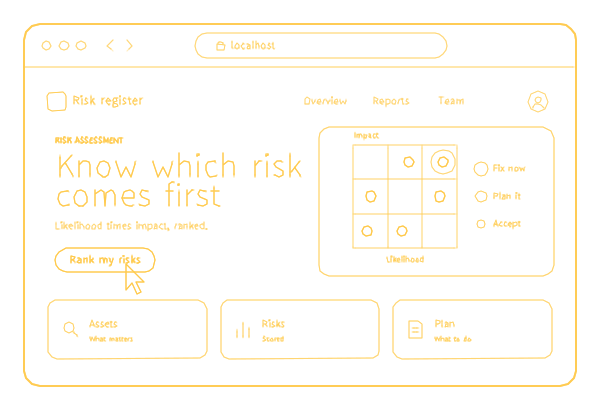
Before you pay anyone, try the rough version with the people who run the business. List ten things that could go wrong, rate each from 1 to 5 for likelihood and for cost, multiply and sort:
| What could go wrong | Likelihood | Cost | Score | First step |
|---|---|---|---|---|
| An admin account without two-factor sign-in is taken over | 4 | 5 | 20 | Two-factor sign-in for every admin |
| Backups exist, but nobody has tried a restore | 3 | 5 | 15 | Restore one system this month |
| A former employee can still sign in to the cloud | 3 | 4 | 12 | Close accounts on the last day |
| A vendor with remote access is breached | 2 | 4 | 8 | List what each vendor can reach |
The numbers are an example, not a benchmark. Give your top three an owner and a date, and write down any risk you choose to live with: who decided, and when to look again. This sketch rates what you believe; an assessment checks what is true.
When a regulation asks for one
If you handle electronic patient data as a covered entity or a business associate, the HIPAA Security Rule from HHS lists a risk analysis as required (45 CFR 164.308). For ISO 27001, SOC 2 or PCI DSS, ask your compliance advisor what your auditor expects. Ours is written so that an auditor can follow it. More on HIPAA compliance.
What you get, and what happens next
Your posture on one page, with the detail behind each rating: that is what cybersecurity posture assessment services should leave you with. A manager reads it in one sitting; an engineer can check every rating.
Systems and threats change, so we can keep the risk register current and review it with you. That is the difference between a one-off report and cybersecurity risk assessment and management services; more on risk consulting. The fixes are remediation, and a rating you want proven gets a penetration test.
How to compare cybersecurity assessment services
In October 2026 I read the five pages Google showed for this search. None publishes a price or a timeline. Four explain how they rate risks; one rates maturity instead. On one, the client testimonials were still the template's placeholder text. Five pages are a small sample, so ask any vendor, us included, to show how one risk gets its rating before you sign.
If you must prove controls against a standard, start with an audit; if two-factor sign-in and tested backups are missing, start with cybersecurity for small business. Otherwise, write one sentence: what your business cannot afford to lose. Send it to us; on weekdays from 9 am to 6 pm Miami time we answer new requests within 30 minutes, then reply with a suggested scope and a rough estimate, free. More on our cybersecurity work.
