
The article
You have seen a model answer questions in a chat window, and now you want it to do real work in your business: answer customers from your own documents, read the forms that arrive every day, take calls, draft replies inside your product. The demo takes an afternoon. Making it work on your data, inside your systems, for people who type things nobody tested, is the part an AI development company is actually paid for.
I have been building software for 18 years. Since 2017 my team at 26 Lines of Code has grown to 70+ specialists and delivered 150+ projects, and clients rate us 5.0 on Clutch from 26 verified reviews (as of September 2026), none of them negative. This page covers what we build with AI, where your data goes, how a project runs, what drives the price, and the questions I would put to any AI vendor before signing, us included.
AI development services at a glance
We do four kinds of AI work, plus a fifth case where AI is the heart of a new product.
| Service | What it does | Fits when |
|---|---|---|
| AI chatbot development | Answers from your policies and documents, checks orders and bookings in your systems, hands the conversation to a person | Customers or staff ask the same questions every day |
| AI integration | Search, summaries, document reading and drafts inside software you already have | Your product works, and a model could do part of a task in it |
| AI automation | Requests sorted, data entered, invoices checked, reports compiled, calls answered | Routine work eats your team's day |
| AI consulting | Where AI pays off, what it will take and what to build first | You are not sure yet what to build |
| A new app with AI inside | A web application or a mobile app built around a model | The AI is the product, not a feature of one |
AI work has no fixed package. Every project gets an individual estimate: the first call and the rough estimate are free, and the price goes into the contract before work starts. When a new app needs AI inside it, our AI application development services start with the app: its first version costs from $5,000, and the AI part is estimated with it.
What an AI software development company builds besides the model
The model is one part of an AI product, and usually the smaller one. Most of the work is ordinary software around it:
- The data it reads. Your documents, catalog, tickets or call notes, cleaned up and indexed, so the model answers from them and not from memory.
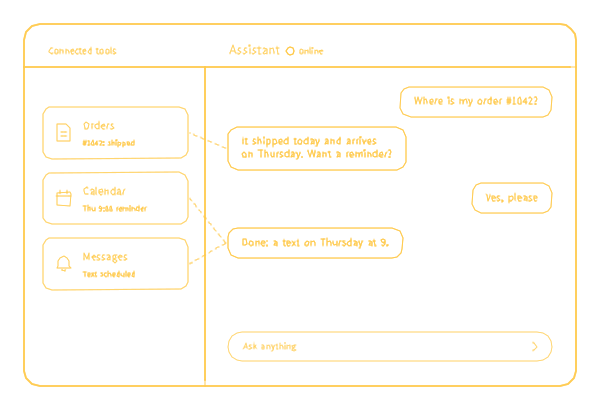
- The connections. Your CRM, email, calendar, order system or ERP, so the AI can check an order or book a visit instead of only talking about it.
- The screens. Where people ask, approve and correct: a chat window, a panel inside your product, a button in a tool your team already uses.
- The checks. Access rules, a test set of real questions with the right answers, a log of every call and limits on cost.
- The running. Hosting, monitoring and model updates after launch.
That is why I call us a software company first. The same 70+ specialists who build web and mobile apps (engineers, designers, QA, DevOps and managers) build the parts around the model, so the AI does not stop where the demo stopped.
Language models handle text and speech, and most of what this page describes runs on them. Where your own data has to teach the system, for sorting, forecasts or recommendations, we build machine learning models instead, so our AI and ML development services cover both kinds.
When custom AI development is not worth it
Part of the job of a custom AI development company is saying when not to build. A custom build does not pay off when:
- A ready tool already does the job. For answers from one page of FAQs, a chatbot builder is enough.
- The task is rare. A report you put together four times a year does not repay an automation.
- Nobody can say what a right answer is. Without examples of correct answers there is nothing to test against, and an untested model can be confidently wrong in front of your customers.
- The knowledge is not written down yet. If it lives in three people's heads and a box of paper, the first project is getting it on record, not AI.
It does pay off when the AI has to act in your systems, follow your rules, keep your data where you need it or know a large catalog. On the first call we tell you which case you are in.
Which AI service fits your problem
Forward this table to whoever asked for "some AI". The middle column is where to start; the last one is what to have ready.
| What you want | Start with | What we need from you |
|---|---|---|
| Customers answered at any hour, from your own policies | AI chatbot development | Your documents and prices, and the systems the bot checks |
| A model doing part of a task inside your product | AI integration | Access to the code and APIs, and real questions with the right answers |
| Your team freed from sorting, copying and chasing | AI automation | A walk through the process as it really runs, in your tools |
| Calls answered and booked around the clock | A voice agent, part of AI automation | The questions callers ask, and the calendar or CRM it books into |
| A new product built around AI | A web or mobile app | The idea, the users and what the first version must do |
| A plan before any of this | AI consulting | Your processes, your data and your goals |
A small business with one routine to hand over has its own page.
Where the model runs and where your data goes
I would ask this question first, of any vendor. We work with two setups and agree on one before we build:
- Hosted models from the major providers, through their APIs. Quick to start and paid per use, under the provider's business terms.
- Open models on your own servers, when the data cannot leave. For a call center in the UAE we built a voice agent that takes inbound calls and makes outbound ones on local infrastructure, with locally hosted models, so all AI processing stays inside the country. The details are in the AI call center case.
Either way, a model sees only what the person asking may see, and every call is logged, so you can see what it did and why. We do not name a favourite provider on this page: the right model is chosen per project, and the choice can change. In the After Effects plugin we built, the backend swaps AI models without a plugin update, so the product keeps up as models improve.
How we build: a person in a pair with AI agents
Anyone selling AI should use it on their own work, and we use it through the whole build. Each project has a person in charge who works in a pair with AI agents. The agents take the routine of a build; the person makes the decisions and signs off on what ships. We do not train AI on our clients' code. We build into our agents the best practices my team has arrived at over the years.
Our pipeline has five steps, and the order is the point: documentation first, then planned tasks, each task built and checked against its plan, a code review by an engineer, and our tester last. Among the sites built this way, Somatic Reset went from an approved plan to its production domain in 8 days and had 157 automated tests two days later. Where AI speeds up a build and where we keep it on a short leash is in a post of its own.
How an AI project goes
- Initial call. The work you want AI to take on, the tools it lives in and the data it touches. If you need an NDA, we sign it before you share details.
- Q&A and a rough estimate. Time and money, with the assumptions behind them. Free and non-binding.
- Agreement. Scope, budget and timeline go into a contract.
- Build and release. Two-week sprints, each ending with a demo of working software, then deployment and support.
Your part is real examples of the work (the questions customers ask, the documents that arrive, the calls that come in), access to the tools the AI will live in, and a person who can say whether an answer is right. You talk directly to the AI software developers on your project. A new request gets an answer within 30 minutes on weekdays, 9 am to 6 pm Miami time; the delivery center near Kyiv is usually seven hours ahead, so a Miami morning is already its working day.
What custom AI development costs
Nobody can price "an AI" honestly before seeing the work. Our estimate for AI software development services rests on five things:
- The data: digital and in one place, or scattered, scanned and half in people's heads.
- The systems to connect: one inbox, or a CRM, an ERP, a phone line and a calendar.
- How accurate it must be: a draft that a person checks, or an action with nobody checking.
- Where the model runs: a hosted model paid per use, or your own servers and the hardware under them.
- Volume: a steady trickle of requests, or thousands with peaks.
Ask for two numbers, from us or any vendor: what it costs to build and what it costs to run each month. GPUs are expensive, and architecture moves the monthly bill. In the After Effects plugin, GPU workers start on demand, so the product never pays for idle hardware.
For reference, our published starting prices: the first version of a web application or a mobile app from $5,000, and developers who join your team from $35 an hour, depending on the role. All of them are on the pricing page.
AI software we have shipped
An AI app development company should be judged by apps that real people use. Three from our portfolio, with what was hard in each:
AI Call Center, UAE. The task: a call center whose data could not leave the country wanted AI to take the routine calls. We built a 24/7 voice agent on local servers with locally hosted models, delivered as a lean MVP designed to grow into a high-capacity system. The hard part was keeping the MVP lean without cutting what callers actually need, and moving at MVP pace under the security standards a call center requires.
AAE Plugin, USA. Artists and video creators wanted to generate and edit images and short video fragments without leaving Adobe After Effects. We took it from a technical demo to a product: AI tools inside the After Effects interface, in-painting with masks, licensing by subscription tier, and one admin for tasks, licenses and hardware. The hard part: images, masks and video frames travel together to the models and back, and the backend had to stay affordable while models change.
HirePilot, USA. A job search product we co-founded and built end to end: a browser extension fills in applications, a dashboard tracks every role, and AI finds hiring managers and drafts personal messages to them. The hardest piece was an extension that reliably fills application forms that vary and change all the time. At launch it was #13 Product of the Day, with a 5.0 rating on Product Hunt; hirepilot.co counts 1000+ job seekers.
Sometimes the AI belongs to the client, and our job is everything around it: for SaneBox, an email assistant that sorts mail with AI, we designed and built the Android app.
Questions to ask any AI development company
Before writing this, I read the company pages Google showed me for this search in October 2026; the rest of the first page was lists, a forum thread and directories. None of the three publishes a price. None says where a client's data would be processed or whether it can stay on the client's servers. One describes how it tests a model's answers before release. Three pages are a small sample, so take it as a reason to ask, not as a statistic.
| Question | A good answer | Ours |
|---|---|---|
| Where will the model run, and who can see our data? | A named setup: a provider's API under its business terms, or your own servers | Agreed before the build; your servers when the data cannot leave |
| Will our data or code train anything? | A plain no, or exactly what and where | We do not train AI on our clients' code |
| How do you test answers before our users see them? | A test set of real questions with the right answers | Checked before release and watched after |
| What does it do when it is unsure? | It says so, or passes to a person | Our chatbots hand the conversation to your team with everything said so far |
| Can we see what it did and why? | A log of every action | Every call is logged |
| What will it cost to run each month? | A number next to the build price, with limits | Costs are watched after release |
| What happens when a better model comes out? | The model changes without a rebuild | The After Effects plugin swaps models without an update |
| Who fixes it when a connected tool changes? | The team that wrote the integration | We write, test and support our integrations |
| Who owns the code? | You, once it is paid for | The code we write for you is yours once it is paid for |
Testing an AI system the way an attacker would, against prompt injection and data leaks, is a service of its own: AI cybersecurity.
What you own
- The code we write for you is yours once it is paid for.
- Your data is read by the model under the access rules we agree, on a hosted model or on your own servers.
- A hosted model stays its provider's: you use it under the provider's business terms. An open model on your servers runs on your hardware.
Where to start
Tell us what you want AI to take on: the task, the tools it lives in and the data it touches. We reply with what is possible, what it takes and a rough estimate, free. If you would rather have our engineers inside your own team, that is staff augmentation; if the AI is part of a new product, it starts as a web application or a mobile app.
