The article
Every security vendor who calls has a product that would make you safer. Next year's budget is due, and nobody in the room can say which of those products to buy first, or whether to buy any. That question - what to protect, against what, in what order and for how much - is what cybersecurity strategy consulting answers, before the money is spent.
I have been building software for 18 years. Since 2017 my team of 70+ specialists has delivered 150+ projects, and clients rate us 5.0 on Clutch from 26 verified reviews (as of September 2026), none of them negative. Below: what goes into a strategy, how it differs for a startup and an enterprise, what a one-page security roadmap looks like, and when a strategy is the wrong thing to buy. In those cases another of our security services fits better.
Cybersecurity strategy consulting: the short version
| What | How it works |
|---|---|
| For whom | Companies at a turn: the first enterprise clients, a new market, new rules, fast hiring |
| What you get | What matters most, the threats that are real for you, a roadmap for one, two and three years, a budget and an owner for every part |
| How it starts | Interviews with the business, then an assessment against a recognized framework |
| Price | The first call and the rough estimate are free; the work is estimated before it starts |
| How long it holds | Until the business changes; we suggest a review at least once a year |
| After that | Our engineers can do the work the strategy calls for, or support your team doing it |
Start from the business, not from tools
A tool answers a threat; a strategy decides which threats deserve an answer. So the work starts with three questions about the business, not the network: what you must protect, what it would cost to lose it, and which clients and rules you answer to. Products come last.
One project of ours shows the order. AI Call Center is a call center in the UAE whose data may not leave the country, so a voice agent on foreign cloud models was never an option. The business rule came first, and it decided the architecture: local servers and AI models hosted inside the UAE. A security strategy works the same way: the constraint you cannot break shapes every choice after it.
What goes into the strategy
Five parts, each written so that someone outside security can act on it:
- What matters most. The data, systems and processes the business cannot lose, ranked by what losing them would cost: a day without orders, a client's data in public, a deadline set by a regulator.
- The threats that are real for you. Not a list copied from an industry report: who would come after a business like yours, how they would get in and what they would want.
- A roadmap for one, two and three years. The first year in quarters, the next two in broader steps.
- A budget, with what each step buys. Every line names the risk it lowers or the client requirement it meets, so a cut is made knowingly.
- An owner for every part of the plan. A name, not a department.
A strategy for the stage you are at
The same five parts look very different at 15 people and at 1,500.
| Stage | Where the strategy starts | A first move, for example |
|---|---|---|
| Startup | The controls your first enterprise clients will ask for, without slowing the product | Answers to security questionnaires, written once and kept current |
| Growing company | A security program that keeps up with new people, offices and systems | Access given and removed on the day someone joins or leaves |
| Enterprise | One strategy across many teams, vendors and rules | One set of rules every team follows, and one list of vendors with what each can reach |
Cybersecurity strategy consulting for startups is short by design: the controls your first enterprise clients will ask about, in the order they will ask, and nothing that slows the product down. When a client asks for SOC 2, the strategy hands over to compliance consulting; the report itself comes from an independent auditor, and we prepare you for that audit.
Cybersecurity strategy consulting for enterprises solves the opposite problem: many teams, vendors and rules, and one strategy that has to hold them together. There the work is less about new controls and more about who decides, which rules apply to whom and how each business unit shows it follows them.
See the document before you pay for it
In October 2026 I read the firms' pages among Google's first ten results for cyber security strategy consulting: there were three, next to a "top 20" list, forum threads, a social post and a directory. All three argue that a strategy fails without execution, and all three sell the execution. None shows what the strategy document contains, none mentions startups, and none publishes a price. Three pages are a small sample, but whoever you hire, ask to see a sample roadmap before you sign.
What a one-page security roadmap looks like
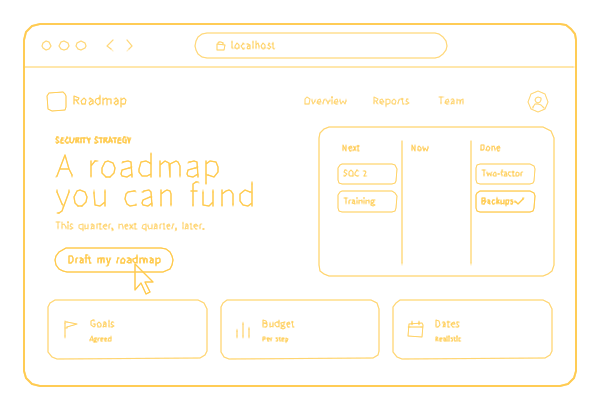
Here is what one page of a roadmap can look like for an example company: a software business of about 60 people whose first large clients have started asking security questions. It is an example, not a client's plan; a real roadmap also carries the cost of each line, which depends on your systems.
| When | Step | What it buys | Owner |
|---|---|---|---|
| Quarter 1 | Two-factor sign-in on email, cloud and admin accounts; one list of who can reach what | Closes the easiest way in | IT lead |
| Quarter 1 | A backup copy no admin account can delete, and a restore test | A bad day costs days, not the company | DevOps lead |
| Quarter 2 | Written answers to the security questions clients ask, kept current | Deals stop waiting on security | CTO and head of sales |
| Quarter 3 | Logs and alerts on the systems that matter, with a person behind the alerts | Trouble noticed while it is small | CTO |
| Quarter 4 | An incident plan, tested once with the team | The first hour of an incident goes by plan | COO |
| Year 2 | SOC 2 or ISO 27001 readiness, if clients ask for it | A report or certificate from an independent auditor to show clients | COO |
| Year 3 | Security testing built into every release | Holes found before clients find them | CTO |
A board member can read it in one sitting and see what each line buys and who answers for it. That is the test of a roadmap: if it needs a security expert to explain it, nobody will follow it.
How it goes
- Interviews. The business, its systems, its data and what worries you most, with the founders or executives, the CTO and whoever runs operations. If you need an NDA, we sign it before you share details.
- Assessment. Where you stand against a recognized framework, such as NIST CSF, ISO 27001 or CIS Controls, gap by gap. On its own, that step is assessment consulting.
- Roadmap. What to do first, next and later, with owners and costs.
- Support. Help putting it in place, and a review as the company changes.
What you bring: time with the executives, a list of your systems and vendors, and the security questions your clients and insurer already ask.
What the price depends on
The first call and the rough estimate are free, and the work is estimated before it starts. The estimate moves with:
- the size of the company and the number of teams, offices and vendors in scope;
- whether an assessment exists or has to be done first;
- the rules and frameworks the strategy has to answer to;
- how far ahead it plans;
- whether our engineers then help carry it out.
When a strategy is the wrong purchase
- A team of ten and one office. Set up the basics first - two-factor sign-in, backups that restore, updated devices - through cybersecurity for small business.
- An audit next quarter. Prepare for it directly with audit consulting, and write the strategy once the audit is behind you.
- A list of findings already in hand. If a test told you what is broken, fix it first: remediation.
- Nobody to keep the plan moving. A strategy without an owner decays; a part-time security lead through managed cybersecurity consulting reviews it with you every month.
Keeping the strategy alive
A strategy holds until the business changes: a new product, a new market, a new rule. For PBM Source, compliance software for pharmacy benefit managers, we delivered a dashboard where every new law, regulation or guidance arrives as a task with a summary, a jurisdiction and a date. A security strategy needs the same reflex: a change in the business is a reason to review the plan, not a footnote to it. Between changes, we suggest a review at least once a year.
Who writes it
With us, strategy sits next to engineering: our consultants work beside the engineers who test, watch and fix systems, so we write only what we could carry out with you. Next to the strategy sit risk consulting for the ratings the budget follows, OT consulting if you run plants and cloud security consulting for your cloud accounts; the rest is on the cybersecurity consulting page.
On weekdays from 9 am to 6 pm Miami time we reply to a new request within 30 minutes. Tell us where your company is headed, and we reply with how we would build the strategy and a rough estimate, free.
