The article
Many guests who find you on a travel site open your own site before they book. They want real photos of the room, the cancellation terms, the parking and the full price. What they find in the next minute decides whether they book with you or go back to the travel site, which then takes its commission from you.
I have worked in software for 18 years and founded 26 Lines of Code, which since 2017 has grown to 70+ specialists and delivered 150+ projects. Hotels are one of the industries we build websites for as part of our web development services. Below: what hotel web design has to cover, the shortest path to booking, how guests find a property, what it costs and how to check your site.
The short version
- The job: answer the questions a guest has before booking, then hand them to your booking engine in one tap.
- The core: a page per room type, rates and offers, location, policies, and a Book button on every page.
- The cost with us: from $499, paid upfront, plus $29 a month, billed annually ($348). Booking and payments on the site add $500 each.
- Priced before work starts: several languages, a connection to your booking engine or channel manager, several properties.
- Owned by you: the domain, the site's code, the analytics accounts.
What a guest checks before booking
- The room itself: photos of that room type, the beds, the size, the view and what the rate includes.
- The full price: taxes and fees in the first number they see, not at the last step.
- The terms: cancellation, deposit, check-in and check-out times, children and pets.
- Getting there: the address on a map, distances to the beach, the center or the airport, and what parking costs.
- Breakfast and the rest: what is included, what is extra, what is open in which season.
- A person: a phone number and an email that someone answers.
Each item a guest cannot find sends them to wherever the answer is, usually the travel site.
The pages a hotel site needs
For most hotels, website design starts with these pages:
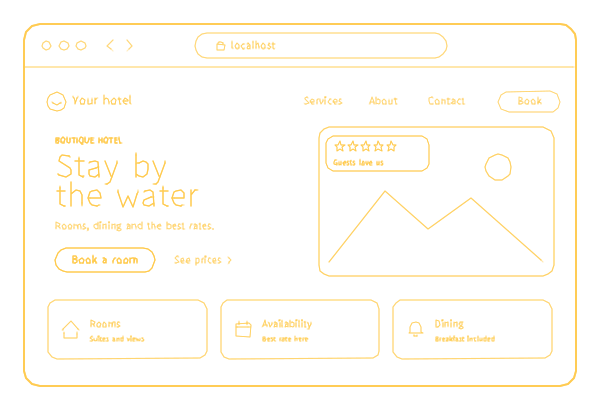
- Home: who you are and where, with a date picker or a Book button on the first phone screen.
- A page for each room type: photos, beds, size, view, what is included, and a Book button that opens your engine with that room when it allows.
- Offers and packages: what is in each, the dates it runs and the conditions.
- Location: a map, how to get here from the airport and the station, what is near and how far.
- Amenities and policies: breakfast, pool, parking, pets, accessible rooms and what they include, all in plain words.
- Groups, weddings and events: what you host, for how many people, and a request form that asks for the dates and the headcount.
- Gallery, about and contacts, plus a privacy policy for the data your forms and analytics collect.
A restaurant that also serves outside guests deserves its own pages; see restaurant websites. The whole list fits into the 20 pages of our $499 website.
The path to booking
Keep the booking engine you have. The Book button on every page opens it; if your engine accepts dates and a room in the link, the guest lands on the price for their stay, not on the engine's start page. Rates and availability stay in your engine, so nothing on the site has to be updated twice.
A guest house that sells only direct and has no engine can begin with a request form for dates, which is in the $499 site, then add our online booking (plus $500) and payments on the site (plus $500). Once the same rooms are also sold on travel sites, availability has to stay in step everywhere, and that is the job of a booking engine with a channel manager; connecting yours is priced before work starts.
Hospitality software is not new to us. For Raina Music, which streams music curated by DJs to hotels and restaurants, we reworked the streaming backend for many venues at once and built live control, so a manager changes the music in each zone from a phone.
How guests find a hotel
People search the place first: hotels in a neighborhood, a boutique hotel in your city, a hotel near the convention center, the stadium or the airport. A location page with real distances and directions answers the "near" searches better than a line on the home page.
Google's hotel results show prices from travel sites next to the property. Ask your booking engine whether it sends your own rate to Google, so a guest sees your price beside theirs. Your Google Business Profile should tell the same story as the site: the name, the address, the phone, the photos and the check-in times. Answer reviews on Google and on the travel sites, the critical ones first.
Guests from abroad read in their own language. Several languages are priced before work starts; each one gets its own titles and descriptions, so search engines show the right one.
Trust signals that turn a look into a booking
- Real photos of each room type, named by room, not one gallery of the best angles. Whatever the hotel design, website photos should match what the guest finds at check-in.
- The total price early. If you charge a resort or cleaning fee, show it in the first price a guest sees; whether federal or state rules require that for your property is a question for your lawyer.
- Cancellation terms in plain words, next to the Book button.
- https on every page, the booking step included.
- Reviews with names and dates, and a phone that a person answers.
What the top hotel web design pages miss, and how to check yours
In October 2026 I measured five agency and vendor pages from Google's top results for hotel web design. Together they carry 172 pictures: two pages give the browser almost no choice of sizes (0 of 13 and 1 of 14), one uses no lazy loading at all, and one describes 22 of its 51 pictures. None of the five names a price for a hotel website, and none says who owns the site and the domain when the work is done. Ask any hotel website design company both questions before you hire it. Five pages are not a market study, but the checks below apply to any hotel site.
| What | Why it matters | How to check |
|---|---|---|
| The Book button | It should reach a price for the guest's dates in few taps | Tap Book on your phone and count the steps to a price |
| The total price | A fee that appears only at checkout loses the booking | Go through a test stay up to the payment step |
| Room pages | Each room type sells on its own photos and facts | Open every room page as a guest would |
| Photo weight | Guests browse rooms on mobile data | Test a room page in PageSpeed Insights on the phone tab |
| Your rate on Google | Your price should appear next to the travel sites | Search your hotel's name and open the prices panel |
| Link preview | A room shared in a family chat shows the room | Share a room page into your own WhatsApp chat |
| Who holds the domain and analytics | A former agency should not own your address or your traffic history | The registrant at your registrar; user roles in Google Analytics |
Which package fits your property
- A guest house or a small hotel with a booking engine: the $499 website with a Book button on every page (full terms on its page), paid upfront, plus $29 a month, billed annually ($348), for hosting and support.
- Booking and payments on your own site: plus $500 each.
- Several languages, a connection to your engine or channel manager: priced before work starts.
- Several properties under one brand, or a design no template has: a custom website.
- A guest portal or your own booking platform: a web application, from $5,000 for a first version.
You register the domain, so it carries your name. Once the site is paid for and delivered, you receive the code, an archive with your files and a data export, and your Google Analytics and Search Console are either created in your account or transferred to it on request. Room tours and other videos are hosted on YouTube or Vimeo and embedded in your pages. During the support year we keep an eye on uptime and on your domain's renewal date (website maintenance has the terms). If you need to know whether the site meets an accessibility standard, ask your lawyer which one applies; our ADA website compliance service checks a site against it. Tour operators have their own page: travel agency websites.
Write to us about hotel web development on a weekday between 9:00 and 18:00 Miami time and the reply comes within 30 minutes. Tell us your room types and the engine you use, and the pricing page has the rest of our numbers.
