The article
Ask your team who could rebuild the test environment from scratch tomorrow, and listen to the pause. When servers, networks and databases were set up by hand in a console, the knowledge of how they fit together lives in one or two heads. Cloud infrastructure management services move that knowledge from heads into files: we manage the servers, networks, databases and release pipelines your software runs on, in AWS, Azure or Google Cloud, and the whole setup is written down as code.
I have been building software for 18 years, and since 2017 my team of 70+ specialists has delivered 150+ projects. Our DevOps engineers work next to the developers who write the code. Within the cloud services at 26 Lines of Code, infrastructure management is the work that keeps the setup written down as code.
Cloud infrastructure management services: the short version
| What | How it works |
|---|---|
| What we manage | Networks, servers and containers, databases, release pipelines, environments and costs |
| How | The setup described as code, kept with your code, every change reviewed |
| Clouds | AWS, Azure or Google Cloud |
| Price | Quoted after we map your infrastructure; the first call is free |
What we manage
- Networks, subnets and firewall rules.
- Servers and containers, and how they scale.
- Databases, caches and queues.
- Release pipelines, from a commit to production.
- Separate environments for development, testing and production.
- Costs tracked per environment and per service.
The last line is the easiest to underrate: when every environment and service has its own line on the bill, a forgotten test setup stops hiding inside the total.
Why the setup lives in code
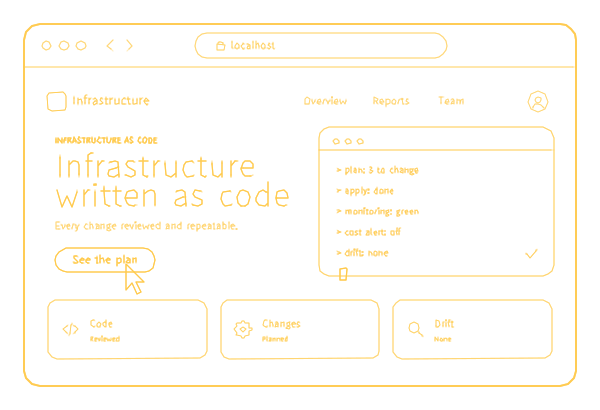
Each server, network rule and database is described in files kept with your code. A change is a reviewed edit instead of a click nobody remembers, and a lost environment comes back from the same files. Testing and production are built from one description, so what passed in testing is what goes live.
Releases follow the same rule. A pipeline takes code from a commit to production the same way every time: built, tested and released without manual steps. Our DevOps engineers build it together with the developers who release through it, and a second engineer reviews every change to the infrastructure before it goes live.
In October 2026 I read the three service pages in Google's first ten results for this search. None of them mentions infrastructure as code, separate environments for testing or a release pipeline. Three pages are a small sample, but those are the three questions I would ask first.
Red flags in an infrastructure nobody manages
Two or more of these, and your setup runs on luck:
- Nobody can rebuild the test environment without the person who set it up.
- Production and testing share a database, "for now".
- Changes are made by hand in the console, and nothing records who made them or why.
- The team shares one admin login.
- A release needs one person's laptop.
- The bill cannot say what each environment or service costs.
- Backups exist, and nobody has ever restored one.
Managed cloud infrastructure services replace that luck with files, reviews and alerts that reach a person.
Our work
AAE Plugin, a generative AI plugin for After Effects, went from a technical demo to a product: GPU workers with no idle hardware costs, a backend that swaps AI models without a plugin update, licensing by subscription tier and an admin that sees every task. For Raina Music we reworked the streaming backend for many venues at once, connected the players to it in real time and wrote the internal documentation that makes new features and onboarding faster.
How it starts, what it costs, what you keep
We map your infrastructure first, then propose what we would manage and at what price; the first call and the rough estimate are free. The map lists every account, network, server and database, who can reach each one and what it costs. A setup your own team built is a fine start: we read what exists, describe it as code where it is not, and point out what to fix first.
If you would rather have a DevOps engineer inside your team, ours can join it through staff augmentation, with specialists from $35 an hour, depending on the role. The difference between the two models is who runs the work, and outsource or outstaff explains how to choose.
The files that describe your infrastructure live with your code, and the cloud accounts and the bill stay in your name.
Next to this service: patches and disks of the servers themselves are cloud server maintenance, a move between clouds is a cloud migration, and the rest of what we run is under managed cloud services. Tell us what your software runs on; the first call is free.
