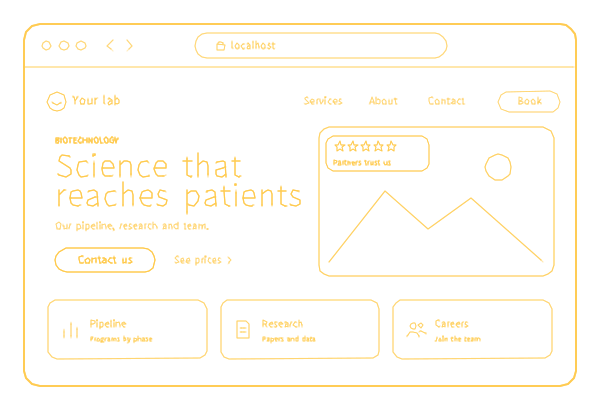
The article
An investor, a partner, a scientist and a reporter can open the same biotech website on the same morning. One decides whether to take the meeting, one whether your platform fits their pipeline, one whether to apply, one whether your news is worth a line. All four start at the first screen, and all four need it to say in one plain sentence what the company does. That sentence is where biotech website design starts.
I have spent 18 years in software development, and since 2017 my team of 70+ specialists has delivered 150+ projects, healthcare and fintech among them. For PBM Source, compliance software for pharmacy benefit managers, we delivered a dashboard where every new law or regulation arrives as a task with a summary, a jurisdiction and a date. Below is how I would plan biotech web design and what it costs; what the $499 package does and does not include is spelled out on its own page. Healthcare and pharmacy have pages of their own, and so do the other industries we work with.
What each visitor comes to find
- Investors: the one-line description, the stage of every program, the team and the latest news.
- Partners: the platform or modality, the data behind it and a named contact for business development.
- Scientists and operations staff: open roles, the city, the lab and the people they would work with.
- Reporters: dated press releases, a media contact, and photos and logos they may use.
- Patients and clinicians, once a program reaches the clinic: what a study is about, in wording your regulatory team approves.
The pages a biotech site needs
A seed-stage company rarely needs more than a dozen pages, and our $499 site has room for up to 20:
- Home: the one-sentence description, the stage and a path to everything below.
- Science or platform, written in layers (below).
- Pipeline: each program with its target, indication and stage, kept current in the admin.
- Publications and posters: title, journal or meeting, year and a link to the source.
- Team: leadership, scientific advisors and the board, with photos and short bios.
- News: dated press releases and a media contact.
- Careers: open roles, the location and a link to your applicant tracking system.
- Partnering and contact: a form that reaches the person who handles business development.
Explain the science in three layers
One page has to serve a generalist investor and the scientist who checks every claim:
- One plain sentence. What the company does and for whom. If it needs a footnote, it is not the sentence yet.
- A short explanation with one diagram. The mechanism or the platform, for a reader who last studied biology years ago.
- The evidence. Publications, posters and data, for the reader who wants to check.
Write the first layer with your CEO and the third with your scientists.
Questions for your regulatory and legal advisors
Biotech is a regulated field, and I am not your lawyer, so these are questions for your advisors before launch, not answers:
- How should the site describe programs that are still in development, so that no sentence reads as a claim that a product is safe or effective?
- If the company is public, which statements need a forward-looking statements notice, and who approves press releases before they go live?
- If a form could collect health information, for example from people asking about a study, what does that require? A contact form on our $499 site is built for business inquiries, and we do not present it as HIPAA compliant.
- Who approves each page, and how fast? A site where every edit waits weeks goes stale anyway.
How investors, partners and candidates find you
Expect most of them to search for your company name, a program code or a founder's name rather than for the word "biotech":
- Each page title carries the company name and the page's subject; "Our Work" alone says nothing in a search result.
- Program codes and founders' names appear in the page text, so a search for them reaches your site, not only a news story.
- A Google Business Profile for the lab helps candidates and couriers find the building; its name, address and phone should match the site exactly.
- The careers page names the city, because candidates search for a role and a place.
The $499 site handles the technical part: a title, a description, structured data and a share preview for each page, plus a sitemap and Search Console.
Where biotech website design loses its readers
Before writing this, I opened five pages from agencies that design biotech websites, all among the top 20 Google results for "biotech website design" in October 2026. Only 23 of their 90 pictures come in more than one size; three of the five pages load every picture without the browser's own lazy loading; 31 pictures have no text description; one page has no link preview picture. None of the five names a price. Five pages prove nothing about an industry, but each number is a test you can run on your own site in a minute.
The content mistakes are easier to spot:
- A home page that needs three paragraphs to say what the company does.
- A pipeline chart that still shows a program the company has stopped.
- Science explained only in PDFs, which are hard to read on a phone.
- Press releases without dates, so old news passes for new.
Check your current site
| What | Why it matters | How to check |
|---|---|---|
| The one-sentence description | It decides whether an investor or a reporter reads on | Show your first screen to someone outside biotech for five seconds, then ask what you do |
| The pipeline | A stale chart reads as a stalled company | Compare each program's stage with your latest press release |
| Named contacts | Partnering and press requests need a person | Send a test message to every address and form on the site |
| The careers path | A broken apply link loses candidates you worked to attract | Apply to your own open role from a phone |
| Link previews | A card with a picture stands out in a LinkedIn feed; a bare link does not | Paste a page address into a LinkedIn post draft |
| The domain | Whoever holds it holds your address and your email | Your own registrar account, not the agency's |
Which package fits
- The $499 website fits a seed or Series A company: the pages above, with an admin where you edit every program yourself. Building it costs $499, paid upfront; after launch, support runs $29 a month, billed annually ($348).
- Online booking adds $500, if partners or candidates should pick a meeting time themselves.
- Other features, such as a password-protected area for investors or a second language, are priced before any work starts.
- A custom website, by the hour or by milestones after an estimate, for a design no one else has or an interactive explainer of your science.
- A web application, from $5,000 for a first version, once you need accounts and data, such as a partner portal.
What stays yours
The domain is registered and paid for by you, the code and a data export come to you in an archive at launch, and Google Analytics and Search Console live in your account or are handed over if you leave. While support runs, we host and update the site, fix our bugs, change your texts and pictures, and watch your uptime and the domain's renewal date, responding within 3 business days (website maintenance).
The price holds because a person works in a pair with AI agents that take the routine, while people make the design decisions and review every page; client code never trains the AI. Build Wise Investments, built the same way, scored 100 in all four Lighthouse categories on a phone in Google's PageSpeed test on October 5, 2026.
Running a clinic or working with pharmacies too? See healthcare and pharmacy websites; the rest of our work is under web development, and our starting prices are on the pricing page. Send us your deck: the first call is free, and you get the price before any work starts.
