The article
A patient choosing a doctor online is not browsing. They need three answers, usually on a phone and often in some pain: do you treat this, do you take my insurance, and how soon can I be seen. A medical website that answers them on the first screens of a phone earns the call. Every other decision in medical website design either helps that or gets in its way.
I am Michael A., founder and CEO of 26 Lines of Code, with 18 years in software development. My team of 70+ specialists has delivered 150+ projects since 2017, healthcare among them. What follows is how I plan website design and development for medical doctors, whether the site serves a solo doctor, a group, a specialty clinic or a med spa. Prices and terms of our $499 site live in their own article. Other industries we build for are listed under websites by industry.
What patients decide on a practice website
A practice site serves two kinds of visitors, and good medical web design means neither has to hunt.
A new patient decides whether to call you, in this order:
- Do you treat my condition, or offer the procedure I need?
- Do you take my insurance, or what does a self-pay visit cost?
- Are you accepting new patients, and how soon is the first visit?
- Who is the doctor: specialty, training, languages, a real photo?
- Where is the office, when is it open, is there parking, is there telehealth?
An existing patient wants a shortcut: the portal login, forms before the next visit, a referral or a prescription question, the phone. Put those in the header, not three clicks deep.
The pages a practice site needs
In medical web page design, each of those questions gets a page of its own:
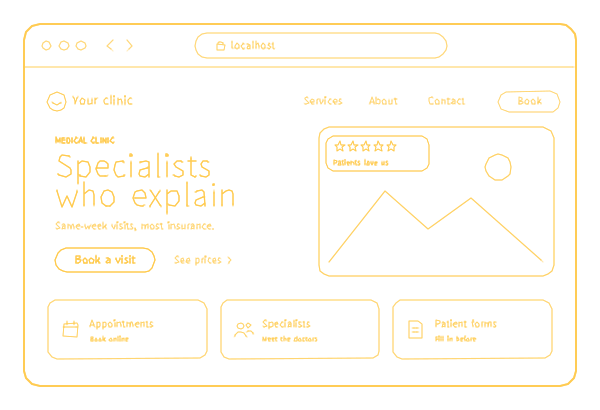
- Home: specialty, location, insurance, the phone and the request button, all on the first screen of a phone.
- A page for each condition and treatment you want patients to find, written in their words: "knee pain", not "musculoskeletal disorders".
- A profile for each clinician: specialty, training, board certification if they hold it, languages, the locations where they see patients.
- Insurance and billing: plans by name, self-pay prices if you publish them, and who answers billing questions.
- New patients: what to bring, which forms to fill in, how the first visit goes.
- Telehealth, if you offer it, and how a remote visit starts.
- Locations: address, hours, parking, a map.
- The patient portal link, contact and a privacy policy.
Count before you order. A solo practice fits easily within the $499 site's limit of 20 pages. A group of six doctors with ten conditions and four standard pages already needs 20; anything beyond that is priced before work starts.
Ask your compliance advisor whether your notice of privacy practices belongs on the site, and where.
Appointment requests, booking and patient forms
There are three ways to get a patient onto your schedule from the site, and they cost different amounts:
- A request form. Included in the $499 site: the patient leaves contact details and a preferred time; your staff call back to confirm.
- Online booking. The patient picks an open slot. Plus $500.
- Your EHR's own scheduling. If your EHR or practice software already offers online scheduling, a link to it may be the cheaper path; a deeper connection is priced before work starts.
For Somatic Reset, a somatic practitioner in Miami, we built a booking engine of its own: live availability; buffers, minimum notice and a booking horizon that the owner sets in the admin; a Stripe prepayment that holds the slot for 10 minutes; and Google Calendar sync. Its private pages carry no analytics. The site reached its production domain 8 days after the plan was approved.
Intake forms are where a medical site meets health information. Ask your compliance advisor whether symptoms, medications or insurance details may go through a website form, where they may be stored and what agreements the hosting and email providers need. Until then, my default is a form that asks for a name, a phone, an email and a preferred time, and nothing clinical.
The same question applies to analytics. The $499 site comes with Google Analytics connected; on a medical site, agree with your advisor before launch which pages may carry it, and any advertising pixel.
Web design for medical spas and cash-pay clinics
A med spa or a cash-pay clinic sells treatments, so its site works more like a menu than a directory:
- A page per treatment: what it does, how many sessions it takes, a starting price if you publish one.
- Before-and-after photos added from the admin, each one only after the patient's consent.
- Deposits at booking: online booking plus $500, payments plus $500.
- Landing pages for campaigns, so an Instagram ad leads to the offer it promised.
Patient photos are the sensitive part. Ask your compliance advisor what consent a patient signs before a photo is published, and who may see the originals. On RxPhoto, a photo platform for dermatology, aesthetics, plastic surgery, vein treatment and wound care, we worked on the backend, the web front end and the API behind the mobile app; the platform keeps an audit log of every user action. That is software, not a $499 website, but it shows how seriously clinics treat a patient's photo.
How patients find a doctor nearby
Patients search by problem, specialty and place: "knee pain doctor", "dermatologist near me", "pediatrician who speaks Spanish", "urgent care open now". A practice site earns those visits with:
- A page per condition and treatment that names the area you serve.
- A separate page for every location, with that location's address, hours, doctors and directions, not one text with the town name swapped.
- A doctor profile that a search for the doctor's name can find.
- A Google Business Profile for each location, matching the site's name, address, phone and hours, and verified in your own account.
- Reviews on Google, and the same details on every directory patients check.
Underneath, the $499 site has the SEO basics in place: structured data, a sitemap registered in Search Console, page titles and descriptions, link previews and pages that load quickly on a phone. Rankings then depend on reviews, competitors and time; a promise of the top spot is a reason to walk away.
What patients trust
- Doctors in real photos, with credentials you can show and the languages they speak.
- Clinical content written or reviewed by a named clinician, with the date of the last review.
- Reviews with names, and a written rule for how your staff answer them. Ask your compliance advisor what a reply may say.
- Prices, or at least what the price depends on, for self-pay services.
- Pages a patient with low vision can use: readable type, strong contrast, a text description on every picture - which our sites have. A formal review is a separate ADA website compliance service; the $499 package makes no ADA promise.
Mistakes I see in medical website design
In October 2026 I measured the pages of five medical website developers, as Google showed them for "medical website design". Three never offer a phone a smaller picture, two have no link preview image, and two load all their pictures, 23 and 40 of them, without the browser's built-in lazy loading. None of the five says a word about who will own the domain, the code or the analytics, a question to put to any medical web design company before you sign.
On practice sites themselves, the same doctor web design problems come up again and again:
- Insurance as "call us to verify", with no list of plans.
- One "Services" page, so no condition has a page that can rank.
- Hours on the site that differ from Google.
- A "Book now" button that only opens a phone number.
- Health questions in a contact form whose answers land in a shared inbox.
- The domain and the analytics in the marketing vendor's account.
Check your practice site in 15 minutes
Before designing a new medical website, check the one you have:
| What | Why it matters | How to check |
|---|---|---|
| Insurance by name | A patient with the wrong plan never calls, and one with the right plan should not have to ask | Count the taps from your home page to the list of plans on a phone; more than one is too many |
| Doctor profiles | Patients choose a person, not a building | Each profile has a photo, specialty, languages and locations |
| New patient path | First visits fill the schedule | One page says what to bring and how to request a visit |
| Form destination | Health details in the wrong inbox are a risk | Submit your own form: where does it land, who reads it, how long is it kept? |
| Analytics placement | Tracking on the wrong pages is a compliance question | Ask which pages carry analytics or ad pixels, then ask your advisor |
| Hours and phone | Wrong hours send patients to the next practice | Tap the number on a phone; compare the hours with Google |
| Domain and analytics | The domain is your address; the analytics are years of history | Your registrar account; in Google Analytics, Account access management under Admin |
Which package fits your practice
- A solo doctor or a small practice: the $499 website, paid upfront, plus $29 a month, billed annually ($348), for hosting and support. You see a first version 5 business days after the payment and your materials; a typical site is live within two weeks.
- Booking: plus $500. Deposits, copays or bill pay: plus $500.
- EHR integration, a Spanish version, editor roles: each priced before work starts.
- A group with many locations, or a design of its own: a custom website, priced after a free estimate and paid by the hour or by milestone.
- Patient accounts, intake or anything that stores health records: a web application, from $5,000 for a first version, planned with your compliance advisor before any code.
Whichever you choose, your name stays on the domain, you receive the code in an archive that any other developer can deploy, and you get admin rights in Google Analytics and Search Console. Support after launch is described on website maintenance, and all prices are on the pricing page.
Medical practice website development can cost this little because the person building your site works in a pair with AI agents, which carry the best practices we have learned over years of projects, never a client's code; a person makes the decisions and checks the result. Clients rate us 5.0 on Clutch from 26 verified reviews, as of September 2026.
This page covers website design for medical practices and clinics. Dentists have a page of their own, and so do organizations with many locations and audiences: healthcare websites. For a practice, your specialty, locations and accepted plans are enough for a free first call.
