The article
People choose a gym the way they choose a phone plan. They compare the price, the terms and the distance, then look at the photos to see whether they would feel at home there. Your website wins or loses that comparison before anyone walks in, often on a phone.
I have built software for 18 years, and my team of 70+ specialists has delivered 150+ projects since 2017. Here is how I would approach fitness website design for a gym, a fitness club or a boutique studio, from what visitors compare to the package that fits. The terms of our $499 site are spelled out in a separate article. If your club needs more than that site, all of our website work is laid out on one page.
What people compare before they join
- Price and terms. The monthly fee, any enrollment or annual fee, the minimum term and how to cancel. "Call for pricing" sends a comparison shopper to the club that shows its numbers.
- Distance and hours. The address, parking, opening hours and, if they differ, staffed hours or 24-hour access.
- The floor. Equipment, free weights, class studios, showers, lockers, childcare - in photos of your club, not of a catalog.
- Classes. The timetable, what each class is and who it is for.
- The first step. A free first class, a guest pass, a day pass or a tour, requested in one tap.
A personal trainer's site answers the same questions on a smaller scale and is closer to a small business website with a booking button. Yoga, Pilates and dance studios have their own pages in our industry list.
The pages a gym website needs
For a single club, everything below fits into the 20 pages of our $499 site:
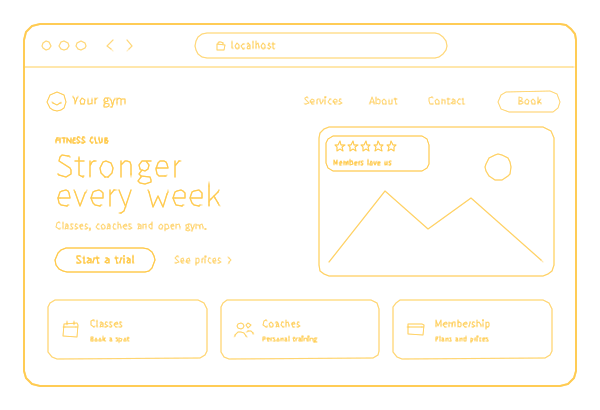
- Home: what kind of gym you are, the starting price, the address and the first step, on one phone screen.
- Memberships: every plan side by side, with what it includes, the fees and how cancelling works.
- Classes: a page per class type, plus the weekly timetable.
- Personal training: trainers with photos, certifications, what each works on, and the packages.
- The club: equipment and amenities, in photos and a short list.
- Location and hours: map, parking, the entrance, staffed hours.
- Your first visit: what the free class or day pass includes, what to bring, where to go at the front desk.
- Questions: freezing a membership, guests, age limits.
- A privacy policy, because every sign-up form collects personal data.
In fitness center website design, kids' programs, corporate memberships or a recovery area each get a page if you sell them.
Joining, booking and paying: the site and your club software
If your club software already handles billing, check-in and class booking, the website should not duplicate it. Decide which tool does which job:
- The $499 site with buttons out. Prices, classes and the timetable live in the admin; "Join" and "Book a class" open your club software. A request form for a first class or a tour comes with the site.
- Booking on your own site: plus $500, for classes or personal training sessions.
- Payments on your own site: plus $500, for day passes, personal training packs or an intro offer paid in advance.
- An integration with your club software, such as its live timetable on your pages: priced before work starts.
- Recurring memberships with member accounts, freezes and cancellations: an application rather than a page, so a web application from $5,000 for a first version. Often a button to your club software is enough.
Before the site sells memberships, ask your advisor whether your state has rules on how members join and cancel online, and what the terms page must say.
For Somatic Reset, a wellness practice in Miami, we built a booking engine with live availability: the client sees open times and pays through Stripe, and the chosen slot stays reserved for ten minutes of checkout. In the admin the owner sets the weekly schedule, exceptions, gaps between sessions and how much notice she needs, and every booking appears in her Google Calendar. It went from the approved plan to the production domain in 8 days. Somatic Reset was a custom website project; for your club, we settle before work starts which pieces fit the +$500 options.
How people find a gym nearby
They search for "gym near me", "24 hour gym", "boxing classes" or "personal trainer" with a neighborhood. Four things help you show up:
- A page per location with its own address, hours, phone, classes and photos. A chain with six clubs needs six real pages, not one list of addresses. For Build Wise Investments, a contractor in South Florida, we built 38 city landing pages with a local FAQ; a different trade, the same mechanics.
- A page per class type, so a search for indoor cycling or kettlebell classes lands on a page about exactly that.
- A Google Business Profile for each club, whose name, address, phone and hours, holidays included, match that club's page.
- Reviews. By Google's own account, how many you have and how good they are both count in local ranking; ask members after their first month.
Every page we build carries the search basics: titles, descriptions, structured data. Nobody controls the map results, so be wary of anyone selling fitness center web design who promises the top spot.
What makes a visitor trust a gym
- Prices and terms in writing, including how to cancel.
- Your own photos at a normal hour, with your members' permission, instead of models in an empty showroom.
- Trainers' certifications, such as NASM or ACE, and what each trainer specializes in.
- Member stories with a first name and consent, with no promise of a set number of pounds.
- Staffed hours and cleaning routines, which matter to anyone comparing 24-hour clubs.
Fitness website design mistakes that send visitors to the next gym
In October 2026 I measured four pages about fitness studio website design that Google showed for fitness, yoga and Pilates website searches, by a design studio and three software vendors. All four have a link preview, but only 29 of their 148 pictures come in several sizes for different screens, and 93 have no text description. None of the four names what fitness web design costs.
On gym sites themselves, look for these:
- Prices only after a call or a sign-up.
- A timetable posted as an image or a PDF that is weeks old.
- A first-step button that leads to a long form or to an app store.
- A full-screen video at the top that takes seconds to start on mobile data.
- All locations squeezed onto one page.
- An embedded booking widget that breaks on a phone.
- A summer promotion still on the home page in November.
Check your site in ten minutes
| What | Why it matters | How to check |
|---|---|---|
| Prices on the site | Comparison shoppers skip hidden prices | From the home page, reach the monthly price in two taps |
| Cancellation terms | Fear of a contract stops sign-ups | Search your own site for "cancel" |
| A current timetable | A wrong time costs a class and trust | Compare this week's site timetable with the front desk's |
| The first step | Every extra screen loses people | On a phone, request a first class from the home page |
| A page per location | Each club competes in its own neighborhood | Search each club's area plus "gym" |
| Pictures sized for phones | Gym sites are heavy on photos | PageSpeed Insights, phone tab: "Properly size images" |
| A link preview | Members send your link to friends | Send it to yourself in WhatsApp |
| The domain and analytics | Your address and data stay yours if you switch developers | Your registrar account; Google Analytics, Admin, Account access management |
Which package fits
- A club or studio site with plans, timetable, trainers, amenities, locations and a first-visit form: from $499, paid upfront, plus $29 a month, billed annually ($348), for hosting and support after launch.
- Booking or payments on the site: plus $500 each.
- Integrations, several languages, other features: priced before work starts.
- Your own design from scratch, or rules no template knows: a custom website, paid by the hour or by milestones after an estimate.
- Member accounts with recurring billing: a web application, from $5,000 for a first version.
Clients rate us 5.0 on Clutch from 26 verified reviews, as of September 2026, and not one review is a bad one. Studios with a narrower focus have their own pages on health and fitness website design: yoga, Pilates and dance.
What stays yours
- The domain, registered and paid for by you, in your name from the first day.
- The code and the design we make for your club, once the site is paid for and done: an archive of code, files and data that any other developer can pick up.
- Google Analytics and Search Console, in your account, or set up in ours and handed over whenever you ask.
Our templates and components stay ours, and your site uses them under a perpetual license. All our prices are on the pricing page.
