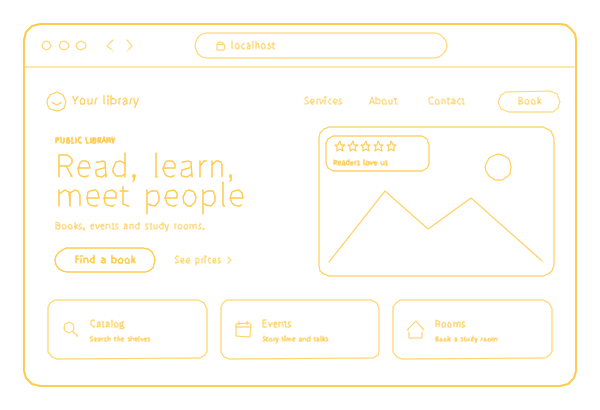
The article
Patrons come to a library website with short questions. Is my branch open today? What is on for the kids this week? How do I get a card? Can I borrow e-books from home? One more question, whether the book is in, belongs to the catalog you already run. Library website development is about the front door: getting each patron to the right answer, or the right system, in one or two taps.
I run a team of 70+ specialists that has shipped 150+ projects since 2017, and I have worked in software development for 18 years. We count public libraries among the sectors we design websites for. This is the plan I would give a public library board, with our prices; the package's full terms live in the $499 website article.
What patrons look for first
- Today's hours for every branch, holiday closures included.
- Programs by age: story time, teen clubs, classes for adults.
- How to get a card, who qualifies and what it gives them.
- E-books, audiobooks and databases, each explained in a line: what it is, who can use it, how to start.
- Rooms, printing, computers and the other services people walk in for.
- A search box that opens your catalog.
The website and the catalog are two systems
Your catalog, patron accounts and holds stay in the system you run today, and so do the e-book apps you subscribe to. The site sends people there: a search box that opens results in your catalog, and a page for each e-resource that links to it.
The pages most libraries need:
- Home, with today's hours and this week's highlights.
- A page per branch: hours, address, parking, building access, services.
- Events and programs, filtered by age and branch.
- Get a library card.
- E-books and online resources.
- Kids, teens and adults.
- About: the board, policies, reports, jobs.
- Support: donations and volunteering.
- Contact.
Many branches can push a site past the 20 pages of our $499 package; a larger site is estimated first.
Accessibility: the federal rule and its dates
The Justice Department's 2024 rule under Title II of the ADA covers state and local governments, and the department lists public libraries among its examples. It sets WCAG 2.1 Level AA as the standard for web content. An interim final rule published on April 20, 2026 moved the deadlines to April 26, 2027 for governments serving 50,000 people or more, and to April 26, 2028 for smaller ones and for special district governments. Ask your counsel whether and how the rule applies to your library, including the documents and outside systems your site links to.
Our written standard puts a text description on every picture and keeps pages from jumping while they load. That is a start, not a conformance review: automated checks catch only part of the problems, and a person has to test the rest. That review is a separate ADA website compliance service, and a $499 site comes with no promise of ADA compliance.
How patrons find you
- If a branch's Google listing and its page disagree on hours, one of them is wrong, and a patron finds out at a locked door. Give each branch a Google Business Profile and keep it in step with the site, holiday closures included.
- A program page shared in a parents' group chat arrives as a card with a picture, because every page has its own link preview.
- Every page of our $499 site carries a title, a description and structured data, and the site comes with a sitemap and Search Console.
Where library sites trip
In October 2026 I looked at five pages about library websites from studios and library software vendors, all among the top 20 Google results for "library website development". Text descriptions are their strong side: 88 of 99 pictures have one. But only 33 of the 99 come in more than one size, two pages load every picture without the browser's own lazy loading, and one has no link preview picture. None names a price.
And on library sites themselves:
- Hours that differ between the site, Google and the sign on the door.
- Library words patrons do not use: ILL, OPAC, "databases" with no word on what is in them.
- An events calendar with hundreds of items and no filter by age or branch: parents look for their child's age, not a date.
- A catalog that opens in a different look, with no way back to the site.
Check your library website
| What | Why it matters | How to check |
|---|---|---|
| Today's hours | A patron who drives to a closed branch stops trusting the site | Open the home page on a phone: are today's hours visible without scrolling? |
| Branch listings | Different hours in two places means one is wrong | Compare each branch page with its Google Business Profile |
| E-resources | A vendor name alone tells a patron nothing | Ask a new patron which link gives free e-books |
| Catalog hand-off | Patrons should find their way back after a search | Search the catalog from the site, then try to return |
| Picture descriptions | Screen reader users depend on them | PageSpeed Insights, Accessibility section, then a manual review |
| The domain | It carries the library's address and email, so it must be in the library's name | Look up the registrant in your registrar account |
Packages for library website development
- The $499 website: branches, events, card information, e-resources and a catalog search box, with an admin your staff use for events, news and closures. The price: $499, paid upfront, and from launch $29 a month, billed annually ($348).
- Room reservations: online booking adds $500. For Somatic Reset we built a booking engine whose hours, exceptions, buffers and minimum notice are set in the admin; we agree on what your rooms need before work starts.
- Event registration with seat limits, more languages or more pages: priced before work starts.
- Catalog results inside the site, patron logins or other integrations: a custom website, estimated first.
The domain is registered in the library's name, the code and a data export come to you at launch, and Google Analytics and Search Console sit in the library's account or move there whenever you ask. While support runs, we watch uptime and the domain's renewal date and respond within 3 business days (website maintenance). If the library is a city or county department, see municipal websites. Prices are on the pricing page; the rest of our web work is under web development.
