The article
A campaign site works to a deadline no other client has: election day. Until then it answers four kinds of visitors. A voter checks who you are and where you stand. A supporter looks for the next event and a way to help. A donor looks for a button that works. A reporter needs a photo, a bio and a statement. Political website development is about putting each answer where that person looks first.
I have worked in software development for 18 years, and the 70+ specialists of 26 Lines of Code have delivered 150+ projects since 2017. Election day sets campaigns apart from every other field we build sites for. Below: the pages a campaign needs, the paid-for-by line, the day after the race and the price. How the $499 package works, down to renewals, is covered in its own article.
The pages a campaign site needs
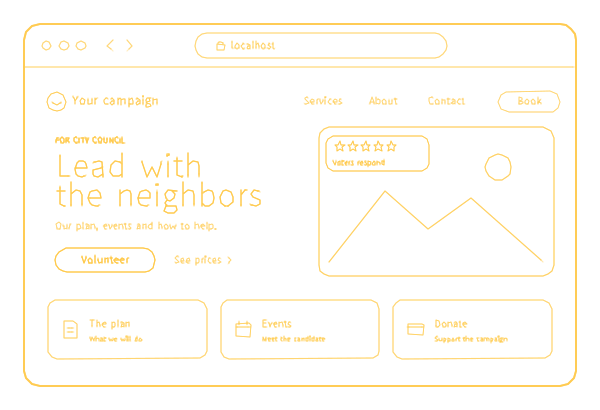
- Home: your name, the office, the district and the election date, with Donate and Volunteer buttons.
- About: who you are and why you are running, with real photos taken in the district.
- Issues: one short page per issue, with a position, not only a slogan.
- Endorsements: who supports you, by name, in their own words.
- Events: date, place and a sign-up form; past events leave the home page.
- Volunteer: a form that reaches the right organizer, with yard sign requests.
- Press: releases, a bio, photos to download and a media contact.
- Donate.
That is eight pages; our $499 site allows up to 20.
The paid-for-by line and donations
For federal races, the Federal Election Commission requires a disclaimer on a political committee's public website (11 CFR 110.11). For a candidate's committee it reads "Paid for by" and the committee's name, and it must be clear and conspicuous. For a state or local race, ask your treasurer or election attorney what your state requires. We put the approved text in the footer of every page.
If you already raise money through a donation platform, the Donate button leads there. Contributions taken on your own site need online payments, plus $500.
Launch fast, and plan for the day after
A working first version is ready 5 business days after the payment and your materials, and most sites launch within two weeks.
Support is $29 a month, billed annually ($348), so a campaign pays for a full year even if the race ends in four months. The plan renews itself each year unless you email us 30 days or more before the renewal date. After the race, the domain stays registered in your name, and you get an archive with the code, the files and a data export. Keep the domain renewed: once an expired domain is released, anyone can register it and put up whatever they like at your old address.
Admin security
An hour after Muzychko Vocal School, a site we built, got its certificate, a bot found the domain in public certificate logs and tried the admin 102 times a minute; we moved the admin to a secret path. Any new site can draw such bots, so ask where your admin lives and who knows the passwords.
How voters find a candidate
- They search your name, then your name with the office or the district. News sites and voter guides compete for those searches, so put your full name and the office in the home page title.
- Use one spelling of your name on the ballot, the site and every social profile.
- Every page of our $499 site gets a title, a description and a link preview with a picture.
Where campaign sites lose supporters
In October 2026 I opened four agency pages and one builder from the top 20 Google results for "political website development". The builder did better on pictures: 57 of its 64 come in several sizes, against 9 of 44 on the agency pages. The agencies publish no prices; the builders on the same results advertise $29 to $50 a month, a fine choice if you would rather build the site yourself.
Look for these on your own site:
- No paid-for-by line, or one in light gray that nobody can read.
- Issue pages with slogans instead of positions.
- Stock photos of flags and crowds instead of you in the district.
- One admin password shared by half the volunteers.
Check your campaign site
| What | Why it matters | How to check |
|---|---|---|
| Paid-for-by line | Federal rules require it on a committee's public site; ask about your state's | Look at the footer of every page on a phone |
| Donate button | A failed payment is a lost donor | Make a small test donation from a phone |
| Events | Past events make a campaign look stalled | Open the events page the morning after an event |
| Volunteer form | A sign-up nobody reads costs you a volunteer | Sign up yourself and see who answers, and when |
| Admin access | A volunteer who leaves should take no password along | List everyone who can log in |
| The domain | It has to outlive the campaign | Check the registrant and the expiry date at your registrar |
The price of political website development
- Building the site: $499, paid upfront: the pages above, an admin your team uses any day, basic SEO and analytics.
- Keeping it up: $29 a month, billed annually ($348), for hosting, fixes, edits to texts and pictures, backups, and a message to you if the site goes down or the domain nears renewal (website maintenance).
- Donations or online booking on the site: plus $500 each.
- Another language, or anything not listed here: quoted before work begins.
- A one-of-a-kind design: a custom website, estimated first.
Once you win, the office's official site belongs to the government, not the campaign: see municipal websites, and ask counsel how to keep the two apart. Other services are listed under web development, and every price is on the pricing page.
